What Is a Sourcing Recruiter? The Role, and When a Desk Needs One
What a sourcing recruiter does, how a sourcer differs from a recruiter, and the honest test for whether your desk needs a dedicated one.
Cover the sourcing half without adding a head - search, verify and score in one pass.
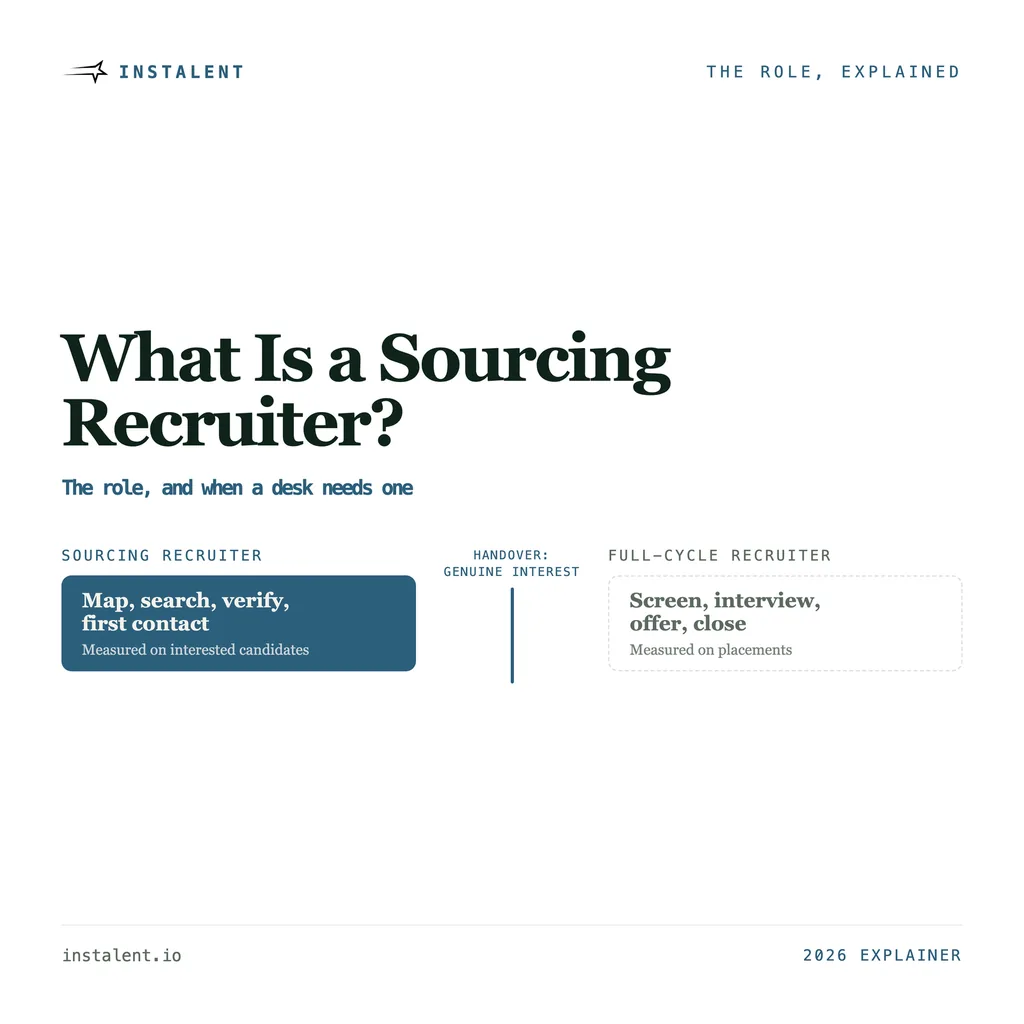
The sourcer-versus-recruiter question gets answered badly because it is usually answered by job description. The useful version is about where the work stops: a sourcing recruiter owns everything up to the point a candidate is genuinely interested, and a recruiter owns everything after. That line is the whole distinction, and it is also the honest test for whether your desk needs someone standing on the left of it.
What is a sourcing recruiter?
A sourcing recruiter - a sourcer - is a recruiter who specialises in the front half of hiring: identifying people who are not applying, verifying a way to reach them, and opening the conversation. They hand over a warm, interested candidate. They do not usually run interviews, own the hiring manager or client relationship, negotiate, or close.
The role exists because the two halves of recruiting need different things. The front half is research and volume. The back half is judgement and relationship management. On a busy desk the second half always wins the calendar, which is why sourcing is the work that quietly stops happening.
Sourcer vs recruiter: where the line sits
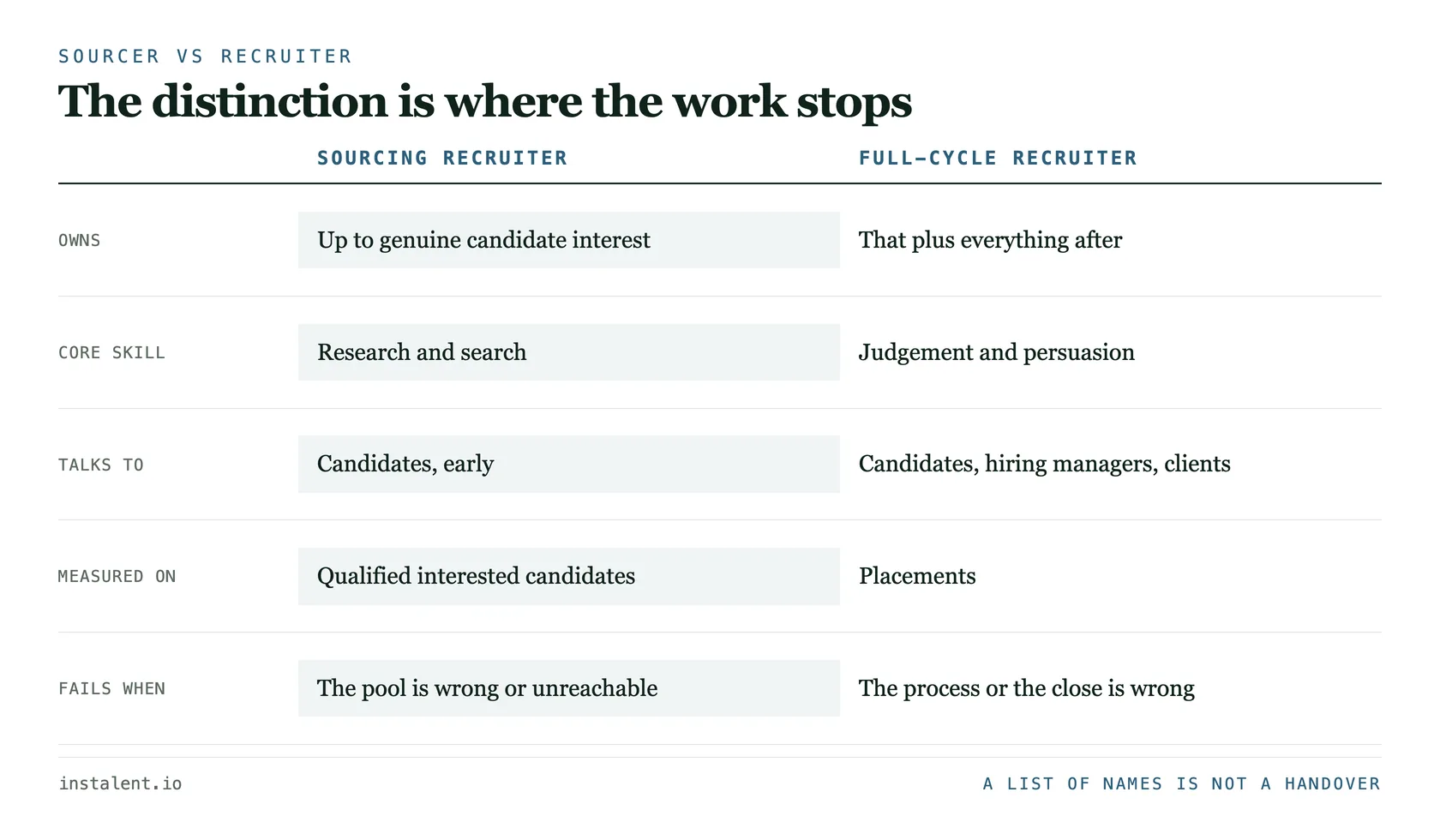
| Sourcing recruiter | Full-cycle recruiter | |
|---|---|---|
| Owns | Up to genuine candidate interest | That plus everything after |
| Core skill | Research and search | Judgement and persuasion |
| Talks to | Candidates, early | Candidates, hiring managers, clients |
| Measured on | Qualified interested candidates produced | Placements |
| Fails when | The pool is wrong or unreachable | The process or the close is wrong |
The word doing the work in that table is interest. A list of names is not a handover. A sourcer's output is a person who knows who you are and has agreed to a conversation - which is why "how many profiles did you find" is the wrong question to ask one, and "how many people are now talking to us" is the right one.
What the job actually involves
Day to day, a good sourcer spends their time on six things:
- Calibrating the brief. Turning "senior backend engineer" into a description of a population - which companies employ these people, what the work is called in each of them, and what they had to have done to be credible.
- Mapping the market. Building the durable view of feeder companies, titles and pay that makes every later search cheap. That is talent mapping, and it is the part most desks skip.
- Searching across sources. Not one database. The strongest evidence is usually somewhere a profile search never indexed.
- Verifying contact details. A shortlist you cannot reach is a list. This step decides whether the rest of the work converts.
- First-touch outreach. Writing something a busy person answers, and following up without becoming noise.
- Keeping a warm pool. Runners-up, past conversations, people who said "not now" - the cheapest source of the next placement.
Technical sourcing is a different job again
A technical sourcing recruiter does the same six things against a population that is unusually hard to read from a profile. Engineers are frequently under-described by their titles and over-described by their activity graphs, so the sourcer's judgement moves to evidence someone else granted - a merged pull request, an accepted conference talk, a maintained dependency.
The limit is worth knowing before you hire for it. GitHub's Octoverse 2025 reports that 81.5% of all contributions now happen in private repositories. Most of the work is not publicly visible, so a technical sourcer who screens only on public output will systematically miss strong people. How to source software engineers goes through what still discriminates.
Do you actually need one?
This is the question the role's job descriptions never answer honestly, so here is a test.
Look at where your reqs die. If roles consistently stall for lack of a credible slate, sourcing is your constraint and it deserves either a dedicated head or dedicated tooling. If roles die at interview, at offer, or in client management, hiring a sourcer will not fix it - and it can make things worse, because you have added candidates to a process that was already losing them.
Split one number before you hire anyone
Take your last twenty closed and abandoned roles and mark, for each, the stage where it actually stopped. Most desks have never done this and are surprised by the answer. A sourcer is the right hire only if the pile is concentrated at the top of the funnel.
Then look at speed. In Bullhorn's 2026 GRID report - nearly 2,300 recruitment professionals - 56% of top-performing firms place in under ten days and 22% in three days or less. You do not reach three days by adding a person who starts searching when the role lands. You reach it because the market was already mapped and the contacts already verified. Dedicated sourcing capacity helps because it is the only way that pre-work reliably happens, not because it adds hands.
The third option most desks skip
The choice is usually framed as "hire a sourcer or don't". There is a third answer: keep the sourcing work with the recruiter and remove the mechanical parts of it.
Most of a sourcer's six tasks are research and verification rather than judgement. Searching across sources, deduplicating the same person found three times, checking whether a contact detail still connects, scoring a long list against a brief - that is exactly the work that expands to fill a week and produces no relationship. The judgement parts, calibrating the brief and writing something a human answers, are not.
Instalent covers the mechanical half: describe the population in plain English and get people from across sources, verified contact details, fit scored against your criteria with the evidence shown, and multichannel outreach with every reply in one inbox - syncing to RecruiterFlow, Greenhouse, Lever or TeamTailor. A recruiter keeps the judgement and the conversations, and stops losing the week to list-building.
That is not an argument against hiring sourcers. Firms at real volume should. It is an argument that "we cannot afford a sourcer" and "we cannot do sourcing" have stopped being the same sentence.
Want the sourcing half covered without adding a head? Get started and run one real role end to end.
Related reading: candidate sourcing strategies is the method a sourcer runs, talent mapping is the asset they build, and the solo recruiter's playbook covers running both halves alone.
Sources
- GitHub Octoverse 2025 - 28 October 2025
- Bullhorn GRID 2026 Industry Trends Report - nearly 2,300 recruitment professionals, fielded November to December 2025
Find better candidates, faster
Source, verify and reach candidates on one engine. Get 25% off your first month.
Keep reading