The Solo Recruiter's Playbook: Running a One-Person Desk in 2026
A solo recruiter has to cover five jobs a 20-person agency splits between people. The operating model that makes that work, and what the growth data says.
Do this in Instalent - source, verify and reach candidates in one flow.

In July 2026, Staffing Industry Analysts published its list of the fastest-growing staffing firms in the United States. Fifty-eight companies qualified, and the qualifying bar is worth reading closely: at least one million dollars of US staffing revenue in the base year, and organic compound growth of at least 15% a year for four years straight. Every firm in the top ten grew more than 55% a year. Several of them still run under 30 million dollars in revenue. Growth at the top of that list is not coming from scale. It is coming from focus.
That is the most useful thing a solo recruiter or a two-person boutique can know right now. The market is not rewarding size for its own sake. It is rewarding firms that pick a lane and go deep, which is the one advantage a small desk has structurally and cannot lose.
The hard part was never the strategy. It is that one person still has to cover every job.
Focus is the actual growth engine
Look at what the fastest-growing firms have in common. Seventy-four percent of them serve one of just three segments: healthcare at 34%, IT at 27% and industrial at 14%. Not a spread across everything a client might ask for. One segment, understood properly.
If you run a desk alone, you already have the thing that produces that number. You know your market's companies, its titles, its comp bands and who moved where. A large generalist firm has to build that knowledge deliberately. You accumulate it by doing the work.
What a large firm has instead is division of labour, and that is the gap worth closing.
The five jobs on a solo recruiting desk, and one pair of hands
A twenty-person agency splits the desk between people. A researcher builds lists. A sourcer works candidates. A consultant runs the client relationship. Somebody chases invoices. Alone, you do all of it, and you do it sequentially, which is the real constraint.
Five jobs have to happen every week whether or not you feel like doing them:
- Find the clients. Companies worth a conversation, plus the person who actually owns the requirement.
- Find the candidates. For live roles and for the roles you want to be trusted with next.
- Get a working contact detail. A person you cannot reach is not a candidate or a client, they are a name.
- Reach out, and follow up. The follow-up is where most of the outcome sits, and it is the first thing to slip when you are busy.
- Keep the record and get paid. Who said what, what was agreed, what was invoiced.
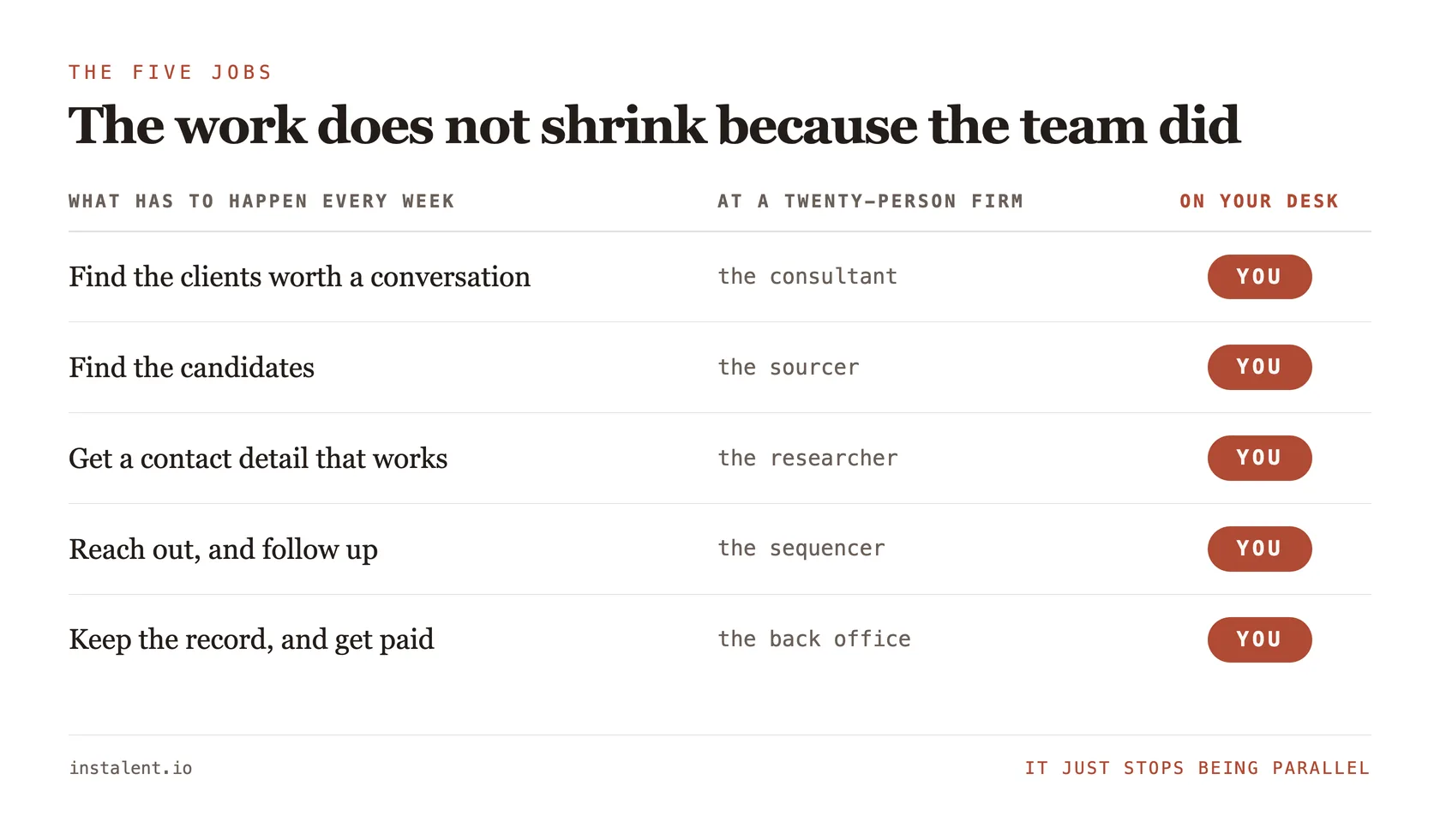
None of these are optional. They are simply invisible until one of them stops, and then it is very visible about six weeks later.
The gap that closes solo recruiting desks
Here is the pattern anyone who has run a desk alone recognises.
You win two roles. You go heads-down on delivery because delivery is urgent and the client is waiting. Business development stops for three weeks, because there are only so many hours. You fill both roles, do good work, invoice, and then look up at an empty pipeline with a six-week gap ahead of you before anything new can land.
That is not a discipline failure. It is arithmetic. Delivery is loud and immediate; BD is quiet and delayed, so under time pressure BD always loses. The fix is not to try harder at it. The fix is to make the quiet work happen without needing a free hour.
Protect the quiet hour, not the busy one
Book the business-development block first, in the calendar, before delivery work fills the week. Ninety minutes, twice a week, treated exactly like a client call you cannot move. A desk that never stops prospecting does not get the six-week hole, and the compounding difference over a year is larger than anything a new tool will give you.
Where a small desk actually leaks time
Be honest about which parts of the week are craft and which are just handling.
Craft is the calibration call where you work out what the hiring manager really means. It is reading a profile properly. It is the phone call where you talk someone through a decision. Nobody should be trying to remove that, and it is the reason clients pay you rather than posting an ad.
Handling is everything else. Building the list. Hunting for a contact detail. Copying names between a spreadsheet, a sequencing tool and whatever holds your records. Remembering that the person who did not answer eleven days ago should be nudged today. None of it is skilled, all of it is necessary, and on a one-person desk it quietly eats the hours that should have gone to craft or BD.
The mistake most solo recruiters make is solving each handling problem separately: one tool for finding people, another for contact details, another for sending, another for tracking. Each is defensible on its own. Together they cost more than the desk earns in a slow month, and the real damage is not the invoice. It is that you become the integration layer between them, moving data by hand, which is a full job nobody is paying you for. We put actual published numbers on that in our breakdown of what a recruiting stack costs.
Four decisions worth making once
You do not need a big system. You need four decisions you stop revisiting.
- Pick the lane, in writing. One or two segments, named specifically enough that you could list the twenty target companies from memory. The SIA data says this is where the growth is; your own pipeline will say it faster.
- Decide where the record lives, and use only that. A proper ATS if you want one, a well-built spreadsheet if you do not. What kills a solo desk is having three half-records.
- Make the follow-up automatic, and the sending deliberate. Sequenced follow-up is what stops good conversations dying at message one. It should still be your judgement that starts each conversation.
- Run one workflow across both sides. Client-finding and candidate-finding are the same motion pointed at different people. Keeping them in one place is where a solo desk gets the leverage a team normally provides.
If you want the client half in more detail, our guides on winning clients, reading buying signals and reaching the person who owns the budget go deeper than this post can.
The unglamorous one: get paid
The REC's Recruitment Industry Status Report for 2024/25, published in December 2025, found that 35% of UK recruitment firms experienced bad debt in the past year. On a desk with several consultants, one bad debt is a bad quarter. On a desk with one, it can be the whole year.
None of this is complicated, it is just easy to skip:
- Terms agreed in writing before you send the first CV, including the rebate schedule.
- A credit check on any new client you have not billed before.
- Invoice the day the placement starts, not at month end.
- A written escalation point in the client organisation, agreed while everyone is happy.
- For contract work, know exactly what you are funding and for how long before you take the assignment.
Nobody ever wishes they had been vaguer about payment terms.
A week that holds together
A workable rhythm for one person, which you can adjust but should not skip:
- Monday: the BD block. New target companies, new conversations, follow-ups on live client threads.
- Tuesday and Wednesday: delivery. Search, shortlist, calls, submissions.
- Thursday: the second BD block, plus every follow-up owed to anyone from last week.
- Friday: records, invoices, and one hour reading your market. Who moved, who raised, who is opening an office.
The point is not the specific days. It is that BD has protected time on both sides of the delivery work, so a busy week can never silently delete it.
Want the leverage of a team without hiring one? Instalent covers all five jobs in one place: find the companies and the decision makers, source candidates in plain language, get verified contact details from multiple sources, run multichannel outreach that follows up on its own, and keep every reply in one inbox, alongside whatever ATS or spreadsheet you already use. Get started for seven days, no card required.
If you are weighing whether to add a dedicated sourcer rather than absorb the work, what is a sourcing recruiter has the decision test.
Sources
- Staffing Industry Analysts - SIA Research Identifies 2026 Fastest-Growing Staffing Firms in the United States (July 14, 2026: 58 companies qualified; criteria are at least $1 million in US staffing revenue in the base year 2021 and organic CAGR of at least 15% over 2021 to 2025; all top ten grew 55% or more and the top five more than 65%; 74% of the fastest-growing firms serve healthcare 34%, IT 27% or industrial 14%; Texas home to the most firms, followed by Florida, California and New York)
- REC - UK Recruitment Industry Status Report 2024/25 (published 8 December 2025: the recruitment industry contributed £40.6 billion to the UK economy in 2024, 1.6% of UK Gross Value Added; 76.7% of that GVA from temporary and contract placements; around 872,000 temporary or contract workers on assignment on any given day; 35% of firms experienced bad debt in the past year)
Find better candidates, faster
Source, verify and reach candidates on one engine. Get 50% off your first month.
Keep reading