Free Recruiting Tools in 2026: Where Free Stops and the Stack Begins
Free recruiting tools go further than most vendors admit, then stop in the same three places. What the paid stack costs after that, and what replaces it.
Do this in Instalent - source, verify and reach candidates in one flow.

Free recruiting tools are better than most vendors will admit. You can find good people with a search engine, read a candidate's public work, keep a pipeline in a free CRM tier and send your first emails without paying anybody. What you cannot do is finish. Free stops in the same three places every time, and the moment it does you start buying: a sequencer, a contact database, a prospecting seat, a search seat. A few renewal dates later you are running a recruiting desk on software built for salespeople.
This is where free stops, what the stack costs once it does, why so much of that spend goes on features a recruiter never opens, and how much of it one recruiting-native platform takes off the bill.
What is genuinely free in recruiting
More than the vendor blogs suggest.
- Search-engine sourcing. Still the best way to find people no database has indexed, and it costs nothing.
- Public work. Code, portfolios, writing, talks. Better evidence of ability than any CV, all free to read.
- Free CRM and ATS tiers. At low headcount these hold a real pipeline without a bill.
- Free tiers on contact finders. A few lookups a month. Enough to test a tool, not to work a role.
Anyone telling you none of this works is selling something. On one role at a time, worked slowly, it works.
Where free stops, every time
Three walls, and they arrive in this order.
Verified contact details. Every free finder caps here, and not out of greed. Confirming a specific person's email or mobile is current today is a live lookup that costs the provider money each time you ask. Nobody gives that away at volume.
Sending at scale. Free plans cap sends, drop follow-ups, or leave out the deliverability controls that keep you out of spam. Sending fifty emails is free. Sending five hundred without wrecking your domain is a paid problem.
Memory. The one people feel last and hate most. Free tools are single-purpose, so nothing remembers who you contacted, what they said, which role it was for, or whether a colleague already spoke to them. You become the integration layer, by hand, every day.
Recruiting is a chain: find, verify, judge, reach, reply, place. Free tools are excellent at single links and none of them holds the chain together.
The tell
If a tool is free forever, look at what it meters. That is the part that costs the provider real money to deliver, and it is reliably the part your search actually depends on.
The stack that free turns into
Once you hit those walls, the shopping list is predictable. This is what recruiters end up paying for, at published prices.
| The job | What gets bought | Published price |
|---|---|---|
| Multichannel sequences and a shared inbox | a sales outreach tool | $109 per user / month |
| Finding client companies and decision-makers | a sales prospecting seat | $119.99 / month |
| Verified emails and mobile numbers | a contact database | billed per record |
| Searching for candidates | a search seat | not published |
| Judging a shortlist against the brief | nothing mainstream | your evenings |
| Whatever you bolt on next | a scheduler, a CRM, an extension | and counting |
Only two of those publish a number, and between them they already reach $229 a month per seat (lemlist Multichannel at $109 per user, Sales Navigator Core at $119.99). Neither sources a candidate. The tool that does will not quote you publicly at all, contact data is billed per record on top, and the list never really closes. There is always one more extension or spreadsheet holding the seams together.
Why generic sales tools waste a recruiter's budget
Because you are buying a whole product and using a slice of it.
Nearly everything on that list was built for a sales team and sold sideways to recruiters. A prospecting seat is designed around accounts, territories, quota and revenue forecasting. A sequencer is designed around booking demos and moving deals through stages. None of that exists on your desk. You pay full price for a feature set aimed at somebody else's job and use only the slice that overlaps with yours.
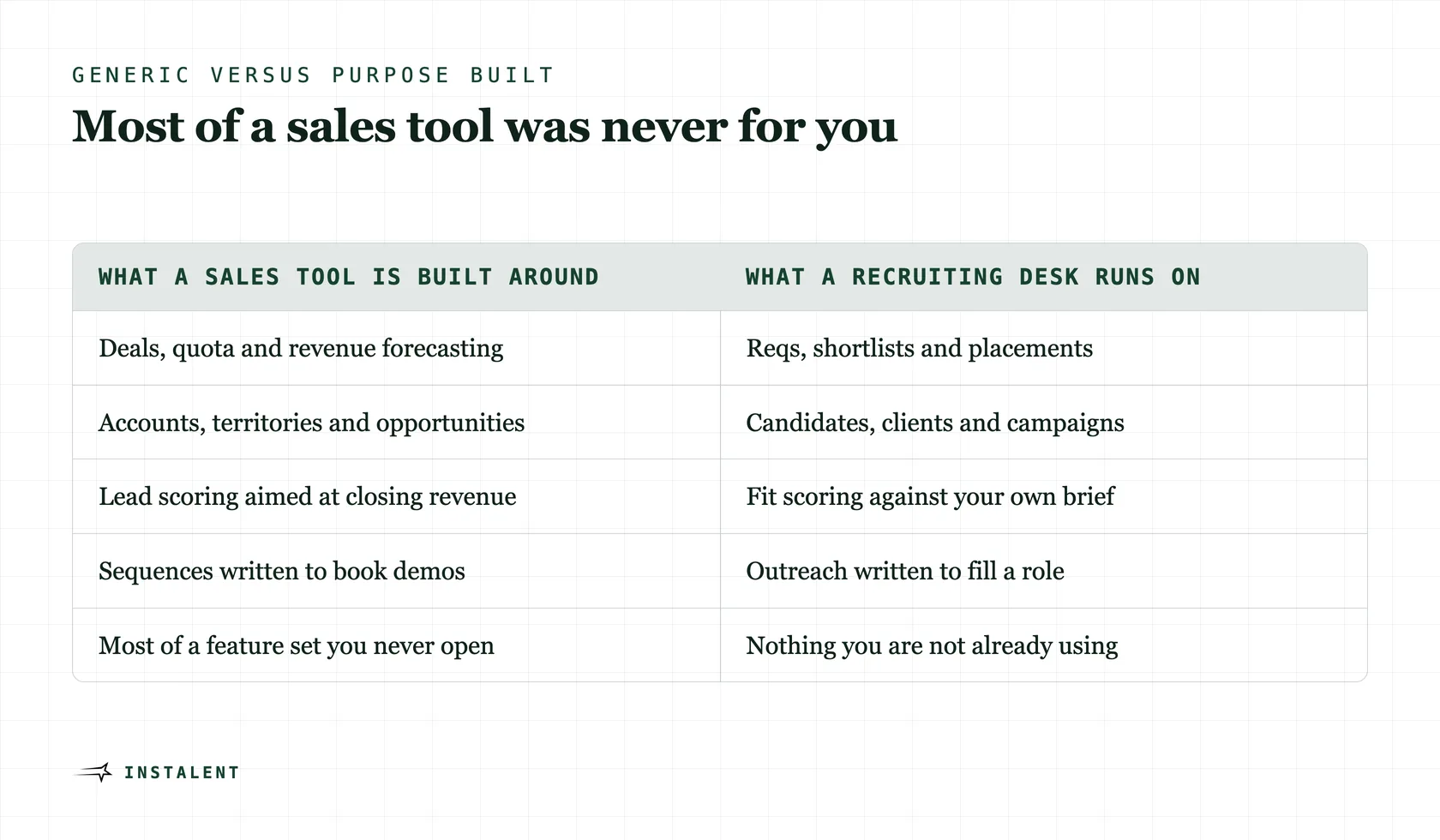
The waste is not only money. There is a translation tax on top: candidates renamed as leads, reqs as opportunities, a shortlist as a pipeline, converted again in your head every time you change tab.
One platform, built only for recruiters
Everything a recruiter needs, on one plan. Instalent covers the same jobs in a single product built for the recruiting chain rather than adapted to it, so none of your spend is carrying someone else's workflow. On the Basic plan at $99 a month, this is what you stop buying separately.
- The outreach tool. Multichannel outreach with personalised sequences and automated follow-ups, so there is no separate sequencer subscription. Paying for a sales-first sender today? Here is the recruiting-native comparison.
- The shared inbox. Every reply, on every channel, lands in one unified inbox, attached to the candidate and the campaign it came from.
- The contact database. Verified enrichment is part of the platform, not a separate data subscription. That is the piece a general-purpose sales database charges you a full seat for.
- The prospecting seat. Client prospecting finds companies that are hiring and the decision-maker to approach, so business development runs where delivery already does.
- The judging you did by hand. AI scoring ranks a shortlist against your criteria with the evidence attached. Nobody was selling you that line item because you were absorbing it in unpaid hours.
The list is not fixed. It grows in the direction recruiters ask for, because recruiters are the only people it is built for. Add the ATS sync to RecruiterFlow, Greenhouse, Lever or TeamTailor and your system of record keeps its job too. Instalent is not trying to replace that. It replaces the general-purpose tools bolted around it.
What changes on the desk is bigger than the invoice. One record per person, so the search result, the verified mobile, the score, the sequence and the reply are the same object, with nothing to rename for a sales data model. One inbox that knows what a candidate is. One motion for clients and candidates instead of paying twice and switching context all day. One renewal date instead of a negotiation and a cancellation window per vendor.
Try the whole thing before you cancel anything
Instalent gives every new account full access from day one. Everything is unlocked: sourcing candidates and clients, verified contact details, AI scoring, multichannel outreach and the unified inbox. Point it at a live role you are actually working. Inside a week you will know whether the contact details are real and whether people reply, which is the only test that matters.
Need longer than a week?
Seven days is the self-serve trial. If you want more time to run it properly with your team, talk to us and we will extend it to 14 days, still with no credit card.
Paying several vendors for software that was never built for you? Get started and run a live role through one that was.
Questions recruiters ask
Is there a genuinely free recruiting tool? Yes, for parts of the job. Search-engine sourcing, public work and free CRM tiers cost nothing and genuinely work. What no free tool gives you at volume is verified contact details, safe sending, or one place that remembers the whole search.
How many tools can one recruiting platform actually replace? There is no fixed number, and that is the point. Anything a recruiter buys to source, verify, judge, reach out, handle replies or win clients is in scope, and the coverage keeps widening. Those products are only separate because they were built for sales teams who buy them separately.
Why does recruiting-specific software cost less than the assembled stack? Because you are not subsidising features built for another job. General-purpose tools price in deal forecasting, territory management and quota reporting whether you touch them or not. On published prices that stack passes $229 a month per seat before you have added candidate search or contact data.
Do I need a credit card for the trial? No. Seven days, no card, full platform.
Is Instalent an ATS? No. It syncs two-way with RecruiterFlow, Greenhouse, Lever and TeamTailor. Keep your system of record and replace the tools stacked around it.
Who is it for? Agency, staffing and executive search recruiters, and in-house sourcers working proactively. See recruitment agencies, or our scored round-up of the market to compare first.
Sources
- lemlist pricing (accessed August 10, 2026; Email plan $69/month, Multichannel $109 per user/month, Enterprise custom; enrichment billed per record in credits)
- LinkedIn Sales Navigator, compare plans (accessed August 10, 2026; Core US$119.99/month or US$1,079.88/year)
- LinkedIn Recruiter Lite product page (accessed August 10, 2026; no price published on the product page)
- Pin - The Recruiting Tech Stack Report 2026 (July 3, 2026; 2,000+ organizations, 20,000+ users; 38.8% of teams run four or more distinct recruiting tools day to day)
Find better candidates, faster
Source, verify and reach candidates on one engine. Get 50% off your first month.
Keep reading