Top 10 Sourcing and Hiring Tools for Recruiters in 2026, Scored
The top 10 recruiter sourcing tools and hiring tools, scored out of 25 on the five things a desk actually needs, from finding passive talent to the hire.
See how Instalent compares against the way you source and reach out today.

Recruiting software splits cleanly into two families, and almost nothing sits in both. One family finds people: sourcing engines that index the open web and hand you passive candidates. The other runs the hire: applicant tracking systems that manage a pipeline once the candidate already exists. Buy from the wrong family and you will spend the year paying for the half you already had. These are the top 10 sourcing and hiring tools for recruiters, each scored out of 25 against the five things a working desk needs.
The market has stopped rewarding the desks that just work harder. Bullhorn's GRID 2026 report, built on responses from nearly 2,300 recruitment professionals, found that firms using AI at any stage of the workflow were 3.5 to 4.5 times more likely to have grown revenue in 2025, and that top-performing firms were four times as likely to be using it at all. But only 10% had AI embedded across a full workflow. That gap is the story of this list: plenty of teams have bought a tool, very few have bought a workflow.
If you are specifically comparing AI-native sourcing engines rather than the full hire cycle, our honest comparison of AI sourcing tools goes deeper on that one category. This guide is the wider view.
What a sourcing and hiring stack costs
Publicly listed prices only, so you can price your own stack honestly. Several of the biggest names publish nothing at all, which is itself a useful signal about how they sell.
- Recruiterflow publishes $149 per user per month for its Platform plan; its AIRA agent layer is quote-only.
- SeekOut starts around $149 per month for Recruit Core, with team plans quote-only.
- LinkedIn Recruiter Lite is about $170 a month, roughly $1,680 a year, with 30 InMails a month.
- Ashby shows a sample Foundations price of $400 a month for companies up to 100 employees; Plus and Enterprise are quote-only.
- Greenhouse publishes plan names - Core, Plus, Pro - but no prices at all.
- hireEZ and Gem publish no list price and gate everything behind a sales conversation.
The five questions a recruiting stack has to answer
Five criteria, five points each, 25 total. These are ordered the way a search actually runs, not the way a feature list is written.
- Finds people beyond one network. Can it surface passive candidates across the open web, code hosts and professional networks, or is your pipeline capped at whoever maintains a profile on a single platform?
- Verified contact details. A deliverable work email and a direct mobile, with a confidence signal, so a good shortlist does not die at the send step.
- Scores fit against your brief. Real evidence-based ranking against your must-haves, not a keyword match that puts the best-written CV on top.
- Runs the outreach and brings replies back. Sequences, follow-ups that do not slip, and every reply in one place.
- Runs the hire, not just the search. Pipeline, stages, scheduling and reporting, so the shortlist has somewhere to go.
Read our own score with a pinch of salt
We wrote this rubric and we make one of the products in it. Instalent scores well because the rubric describes the job we built for - and it deliberately loses points on question 5, because we are not an applicant tracking system. Take the five questions to your own shortlist and score it yourself. Our approach to comparisons, including how to send a correction, is on our comparison methodology page.
The top 10, scored
Scores are our read of each product's publicly documented capability for agency and in-house recruiting work. A low score is not a verdict on the product - it usually means the product was built for the other half of the problem.
| # | Tool | Finds | Contact | Scoring | Outreach | Runs hire | Total |
|---|---|---|---|---|---|---|---|
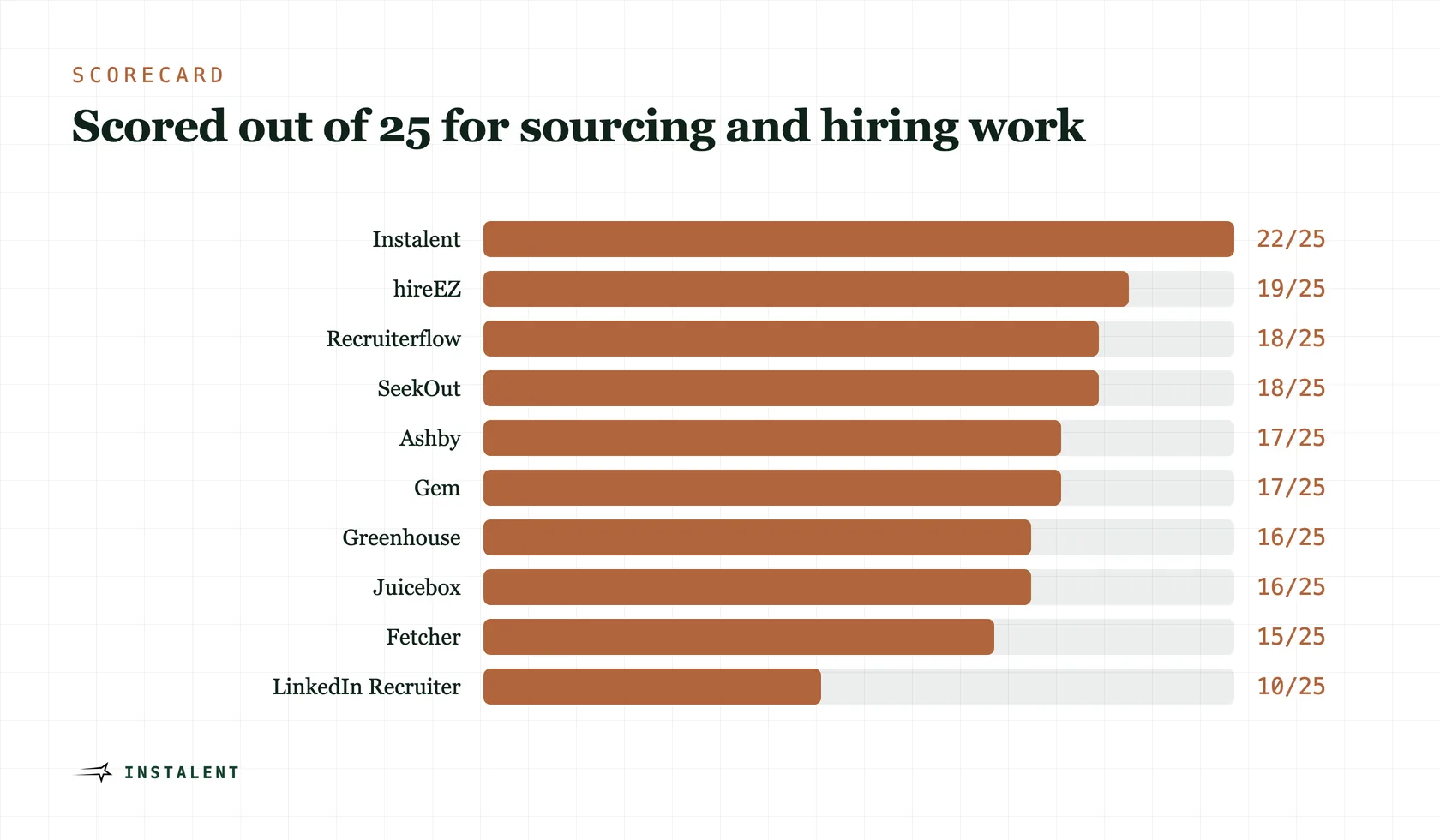
| 1 | Instalent | 5 | 4 | 5 | 5 | 3 | 22 |
| 2 | hireEZ | 5 | 4 | 4 | 4 | 2 | 19 |
| 3 | Recruiterflow | 3 | 3 | 3 | 4 | 5 | 18 |
| 4 | SeekOut | 5 | 4 | 4 | 3 | 2 | 18 |
| 5 | Ashby | 3 | 2 | 3 | 4 | 5 | 17 |
| 6 | Gem | 3 | 3 | 3 | 4 | 4 | 17 |
| 7 | Greenhouse | 3 | 2 | 3 | 3 | 5 | 16 |
| 8 | Juicebox | 5 | 3 | 4 | 3 | 1 | 16 |
| 9 | Fetcher | 4 | 3 | 3 | 4 | 1 | 15 |
| 10 | LinkedIn Recruiter | 2 | 1 | 3 | 2 | 2 | 10 |
hireEZ and SeekOut are the strongest pure sourcing engines here. Both index far beyond a single professional network, both bring contact data with the profile, and both rank against a brief rather than a keyword string. Where they stop is the hire itself: you still push the shortlist into an ATS, and hireEZ gates its pricing entirely. We go deeper in our hireEZ alternative and SeekOut alternative write-ups.
Recruiterflow, Ashby, Greenhouse and Gem are the mirror image. They are genuinely good at running a hire - pipeline, stages, scheduling, reporting - and Recruiterflow in particular is built for agency desks rather than in-house funnels. But their sourcing is fundamentally about the people already near your orbit: applicants, your CRM, your past pipeline. That is a smaller pond than the open web, and it is the pond everyone else is already fishing.
Juicebox deserves credit for making natural-language search normal. Describe the person and it finds them, which is a genuinely better interface than a Boolean string. It is the lightest here on running an actual hire. Our Juicebox alternative covers the trade.
Fetcher takes a different bet: curated batches delivered to you rather than a database you search. That suits a team that wants volume without operating a tool, and it is why it scores well on outreach and poorly on running the hire.
LinkedIn Recruiter scores lowest, and the number needs context. Inside its own network nothing finds a named person faster, which is exactly why it is on every desk. But the rubric asks about the whole job, and by design it is one network, with no verified direct contact details and a monthly message budget. It is a component, not a stack. See our LinkedIn Recruiter alternative for the longer argument.
Where a recruitment CRM fits
Two names get used loosely in this category, so it is worth separating them. An applicant tracking system runs a hire: it holds the pipeline for a live role, moves people through stages, and records the decision. A recruitment CRM holds the relationship instead of the requisition - the people and companies you already know, what was said last time, and who is worth going back to when something opens. On an agency desk the CRM also holds clients, not just candidates.
Most agency platforms now ship both in one product, which is why the two words usually appear together. Neither one finds anybody new. Both work on people who have already reached you - applied, been referred, or been added to a list at some point - which is exactly the boundary the scores above are measuring.
Two families, and the gap between them
Sort the table and the split is obvious. Sourcing engines land 15 to 19 and lose their points at the end of the process. Applicant tracking systems land 16 to 18 and lose their points at the start of it. Nothing in the middle scores above 19.
That gap is not an accident. Finding passive people is a data problem - crawling, matching, verifying. Running a hire is a workflow problem - stages, permissions, scheduling, compliance. The companies that got good at one had little reason to get good at the other, so recruiters bridge it themselves with a stack, a CSV export and a lot of tab-switching.
It is also where the Bullhorn number comes from. Buying a tool is easy; only 10% of firms have AI running across a full workflow because the workflow itself is split across vendors.
Where Instalent lands, and where it does not
We built for the first four questions. Describe a role in plain English and Instalent sources real candidates across the open web, code hosts and professional networks, enriches verified contact details from multiple sources with a confidence signal, scores every profile against your criteria with the evidence shown, then runs multichannel outreach and lands every reply in one unified inbox.
The 3 on question 5 is deliberate and honest: we are not an applicant tracking system and we are not trying to be one. We sync two ways with RecruiterFlow, Greenhouse, Lever and TeamTailor, so the shortlist and the activity land in the system your team already runs the hire in. If you want one vendor for absolutely everything including the ATS, buy an all-in-one and accept a weaker top of funnel. If your bottleneck is finding, verifying and reaching the right people, that is the half we built.
The same engine also works client-side, which is the other half of an agency desk - we scored that market separately in the top 10 client prospecting tools.
Want to score us against your own shortlist? Get started and run one real role end to end.
Run a two-week bake-off
Scores build a shortlist. Your desk decides. Pick one live role and run every finalist through the same test.
- Same brief, same week. Count candidates you would actually submit, not profiles returned.
- Count how many arrive with a contact you would genuinely send to.
- Track replies per 100 sends, not open rates - inbox privacy protections made opens unreliable years ago.
- Time the whole loop, brief to first reply, and log who had to touch it.
- Check the exit: can you export your data, and does it write back to your ATS.
Test the top of the funnel hardest
Every tool here demos well on pipeline management, because that part is mature. The differences that matter show up in the first hour: who the search returns, and whether you can reach them. Make each vendor run your hardest open role, not their sample data.
Common questions
What is the best sourcing tool for recruiters? There isn't one, and any list that crowns a single winner is selling something. Sourcing engines like hireEZ and SeekOut win on finding passive candidates; applicant tracking systems like Ashby, Greenhouse and Recruiterflow win on running the hire. Score both families against the five questions above and buy for the half you are actually missing.
What is the difference between a sourcing tool and an ATS? A sourcing tool finds people who are not yet in your pipeline - it crawls the open web and professional networks and hands you passive candidates. An applicant tracking system manages people already in your pipeline: stages, scheduling, feedback, compliance and reporting. They solve opposite problems, which is why most desks end up paying for both.
Do I need both a sourcing tool and an ATS? Most teams do, and that is the honest answer. The exception is a desk whose bottleneck sits clearly on one side: if you have plenty of inbound applicants and no process, buy the ATS first; if you have process and an empty top of funnel, buy the sourcing engine first.
What are the top 10 recruiting tools? Scored out of 25 against the five questions above: Instalent 22, hireEZ 19, Recruiterflow and SeekOut 18, Ashby and Gem 17, Greenhouse and Juicebox 16, Fetcher 15, LinkedIn Recruiter 10. The ranking matters less than the pattern in it - sourcing engines lose their points at the end of the process, applicant tracking systems lose them at the start, and nothing in the middle scores above 19.
What are ATS and CRM tools? An applicant tracking system runs a hire: pipeline for a live role, stages, and the record of the decision. A recruitment CRM holds the relationship rather than the requisition - the people and companies you already know, and who is worth going back to when something opens. Most agency platforms ship both in one product. Neither finds anybody new.
Are there free sourcing tools for recruiters? Free tiers exist but they are trial-shaped - a small monthly credit allowance rather than a working desk. Treat them as a way to run the two-week bake-off above, not as a stack.
How much do recruiting tools cost in 2026? Published prices in this list run from roughly $149 per user per month (Recruiterflow, SeekOut) to $400 a month for a small-company ATS plan (Ashby). The larger platforms - Greenhouse, Gem, hireEZ - publish no list price at all and quote per deal, which usually means an annual contract.
Sources
- Bullhorn - GRID 2026 Industry Trends Report (February 2026, ~2,300 recruitment professionals surveyed)
- Recruiterflow - pricing (accessed August 2026)
- Ashby - pricing (accessed August 2026)
- Greenhouse - pricing (accessed August 2026)
- SeekOut - pricing (accessed August 2026)
- LinkedIn - Recruiter Lite (accessed August 2026)
Run your own side-by-side test
Source, enrich, score and reach out in one flow, and judge it against your current stack. Get 50% off your first month.
Keep reading