Enterprise Recruitment Software in 2026: Winning Share in a Growing Market
The staffing market is growing again. For enterprise recruitment and staffing firms this is a year won on efficiency: more output from one platform.
Do this in Instalent - source, verify and reach candidates in one flow.

The staffing market is growing again. SIA's March 2026 forecast has US staffing revenue up 1% this year and 2% next, with healthcare, IT and industrial all back in growth. It is steady rather than spectacular, which means this year the growth goes to whoever runs the better desk. Share moves toward the firms whose consultants simply get more done, and that is a variable you control. Good news, if you are willing to look at how the work actually runs.
Growth is back, and it is broad
SIA forecasts 1% growth in 2026 and 2% in 2027 across US staffing, and the growth is broad rather than concentrated. IT, industrial and healthcare are all expanding, with construction and skilled trades singled out as particularly strong, helped by data-centre and energy-related building.
Compounded across the two years that is a market roughly 3% larger. Modest per year, and it accumulates.
The recovery shows at role level too, which matters more to most desks than a headline number. Indeed's index of US software developer job postings bottomed last October and has climbed about 17% since, reaching its highest level since September 2023. If you run a technology desk, that is reqs coming back.
The operating picture is improving alongside it. SHRM's 2026 benchmarking puts median time-to-fill for non-executive roles at 39 calendar days, down from 44. The industry is filling roles faster, into a market that is expanding again.
SIA president Ursula Williams framed the moment well at the Executive Forum in March: "That might not feel like a lot, but compared to the several years of declining growth, we're very pleased to see this."
She is right, and the shape of that growth matters more than the size. In a steady market nobody gets carried. Firms grow by taking share, and share goes to whoever runs the better operation. That makes 2026 a winnable year, because the variable is one you control: output per consultant.
Steady growth rewards efficiency, not extra spend
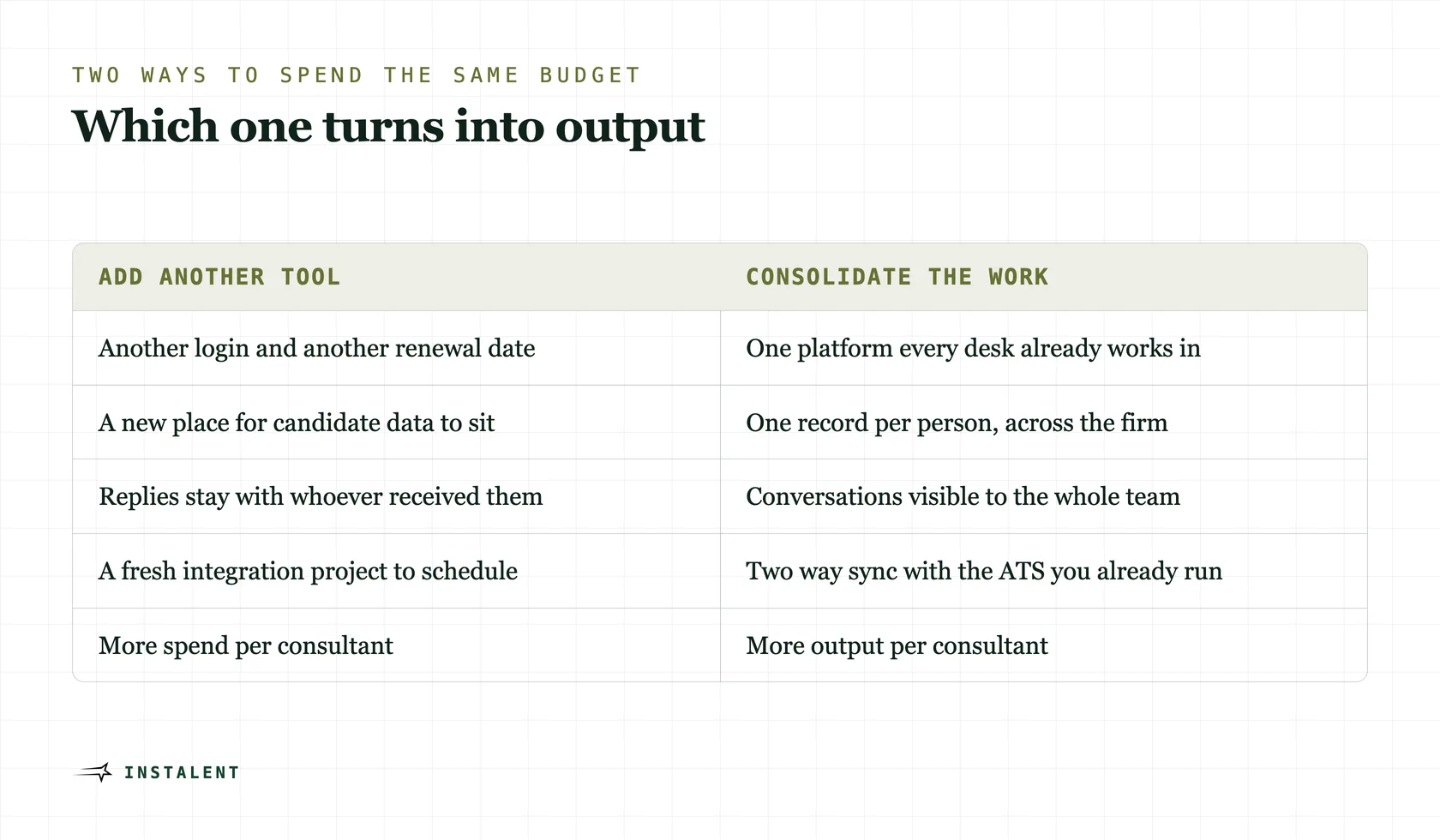
The instinct when targets outrun the market is to buy something: another sourcing seat, another data subscription, another sequencer. It feels like progress because it lands in a week.
The trouble is that it rarely turns into output. The average organisation already runs about 16 HR and recruiting applications, 68% of them disconnected from each other, and 76% of teams report struggling with data silos. Nearly 4 in 10 talent teams run four or more distinct recruiting tools day to day. Every one of those was bought to make somebody faster, and each new one adds a little more of the work that nobody was hired to do: moving information between tools by hand.
That is the efficiency opportunity sitting in most large firms right now, and it does not need new budget. It needs the same work to happen in fewer places.
At scale, the opportunity moves from search to coordination
On a single desk, speed of search really is the constraint, and a faster way to find people pays for itself.
Across fifty desks the maths changes. The advantage is won in the space between consultants, where the same work can quietly happen twice and none of it accumulates. Close that space and every desk gets faster without anybody working longer. It is also the most durable kind of gain: a candidate researched once stays researched for the whole firm.
Worth saying plainly, because the category name misleads: this is not a high-volume staffing problem. The gain is largest at volume, simply because duplicated work has more chances to happen - but it exists anywhere more than one person works the same market. An executive search firm with six partners in the same sector has the same overlap, on fewer and more valuable searches. An RPO team covering one client's several functions has it too. Volume changes the size of the prize, not whether there is one.
Where a large firm has the most room to gain
None of these show up in a demo. All of them show up in a quarter, which is why they are worth attacking.
One approach per candidate, not two. When consultants in adjacent markets can see each other's activity, the second one knows before reaching out. That protects the candidate relationship and your reputation in a small market.
Relationships that belong to the firm. A consultant who has had four conversations with a senior candidate has built something valuable. In a shared record it stays valuable when they are on holiday, on another desk, or promoted.
Client intelligence that travels. One team learns a client is opening headcount in a new region. That is worth far more when the rest of the business hears it in time to act.
Business development and delivery on one system. When the people winning work and the people filling it share a platform, the handover is a record rather than a meeting.
Faster ramp for new consultants. A new starter who inherits visible history of who was contacted, what was said and which approaches landed is productive in weeks rather than quarters.
A test worth running
Pick a candidate your firm placed last year. Ask how many people could reconstruct that relationship's full history today without going to the consultant who owned it. Whatever the answer is, that is the size of the opportunity.
What to require from enterprise recruitment software
At this size the feature list matters less than the operating model underneath it. Six things worth putting into an evaluation.
- Shared by default, not by export. A colleague should see the profile, the history and the replies without anyone sending a file. If sharing takes a manual step, it will not happen under pressure.
- One record per person across the firm. The search result, verified contact details, score, outreach and reply should be the same object, or you are buying another place for data to sit.
- Replies visible beyond the individual. A conversation that lives in one mailbox is knowledge the firm paid for and cannot reach.
- Two-way sync with the ATS you already run. Your system of record should stay your system of record. Anything that asks you to migrate is proposing a project, not a subscription.
- Evidence attached to AI judgements. If a platform scores candidates you need the reasoning behind each score, so it is defensible to a client and reviewable internally.
- A security posture you can hand to procurement. Encryption in transit and at rest, role-based access, MFA on privileged access, and a clear position on candidate data. Ours is set out on our security page.
Running alongside the ATS, not replacing it
The instinct at enterprise scale is to consolidate into the system of record. That rarely works: an ATS is built to store the process rather than run the front of it, and the migration costs a year you would rather spend selling.
The better shape is to leave the ATS where it is and consolidate the work that happens before a candidate reaches it. That is what Instalent does. Sourcing for candidates and clients, verified contact details, scoring against your own brief with the evidence attached, multichannel outreach and a shared inbox for every reply, all on one record and visible across the organisation rather than held per seat.
It then syncs two-way with RecruiterFlow, Greenhouse, Lever or TeamTailor, so nothing about your system of record changes. Client prospecting runs on the same platform, which is what closes the gap between the team winning work and the team delivering it.
It is built for staffing agencies and recruitment agencies specifically, so the spend goes on recruiting work rather than on a general-purpose feature set. We wrote about that distinction here.
Want to see it against a live desk rather than a demo script? Get started, or talk to us about a longer evaluation with your team.
If the decision in front of you is which system of record to run rather than what to add on top of it, Bullhorn alternatives works through that shortlist and, more usefully, through what a migration does and does not move.
Questions from staffing and RPO leaders
What is enterprise recruitment software? A platform that handles sourcing, contact data, candidate assessment and outreach for a recruiting organisation rather than an individual recruiter, with shared records and permissions across teams and integration into an existing ATS. The distinguishing feature at enterprise scale is whether work done by one person is visible and reusable by everyone else.
Do we have to replace our ATS? No. Instalent runs alongside it and syncs two-way with RecruiterFlow, Greenhouse, Lever and TeamTailor. The ATS stays the system of record.
How do we stop two consultants approaching the same candidate? By putting them on the same record. Shared profiles and shared reply history mean the second consultant sees the first one's activity before reaching out.
Can it be evaluated without a full rollout? Yes, and it should be. Put it on one desk with live roles, measure against that desk's normal quarter, then widen. Start on one desk with live roles and, if you want to run it properly with a team, book a walkthrough and we will run it with you.
Is this only for high-volume staffing? No. The coordination gain is largest at volume but it exists anywhere more than one person works the same market, including executive search and RPO.
Related reading: talent acquisition vs recruitment covers the function split enterprise teams are usually buying for, and interview questions to ask candidates covers the stage no platform decides for you.
Sources
- SIA - US staffing revenue to see modest uptick (March 24, 2026; US staffing revenue forecast +1% in 2026 and +2% in 2027; healthcare, IT and industrial each +1%; locum tenens +5% in both years; construction and skilled trades highlighted as particularly strong)
- Indeed Hiring Lab - Software Development Job Postings on Indeed in the United States (series IHLIDXUSTPSOFTDEVE via FRED, data to July 31, 2026; index Feb 1, 2020 = 100, seasonally adjusted. Low of 64.3 on Oct 1, 2025; latest reading 75.5, the highest since September 2023. Data source and owner: Indeed)
- Pin - The Recruiting Tech Stack Report 2026 (July 3, 2026; 2,000+ organisations and 20,000+ users; 38.8% of teams run four or more distinct recruiting tools day to day; average of roughly 16 HR and recruiting applications, 68% disconnected and 76% reporting data silos, all three attributed to HR.com 2025)
- SHRM - 2026 Recruiting Executives Benchmarking (fieldwork Nov 24, 2025 to Jan 23, 2026; median time-to-fill 39 calendar days for nonexecutive roles, down from 44)
Find better candidates, faster
Source, verify and reach candidates on one engine. Get 50% off your first month.
Keep reading