The Failed Search Post-Mortem: You Cannot Run One Without the Record
A search that never filled has a knowable cause, but only if you kept the record. What to capture while it is live, and the order to diagnose it in.
Keep the record while the search runs, not after it fails.
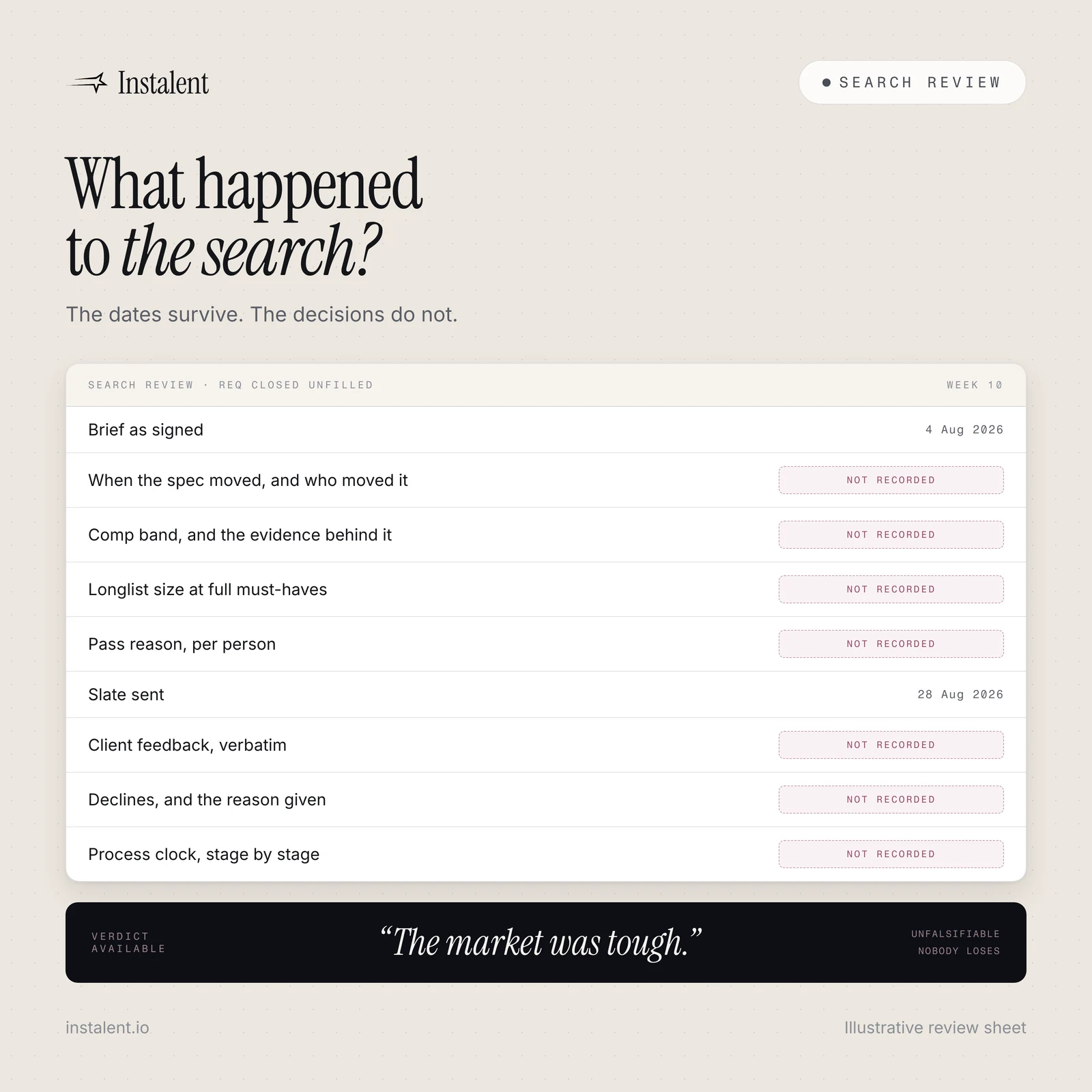
Ten weeks in, the req closes unfilled, or the client hires through someone else, or the role quietly stops being discussed. At some point a partner asks what happened. What comes back is usually one of three sentences: the market was tough, the money was wrong, the client was impossible. Any of them may be true. None of them is a finding, because none of them can be checked, and because the evidence that would settle it stopped existing about six weeks ago.
"The market was tough" is a verdict, not a finding
It wins by default for two reasons. It is unfalsifiable, and nobody in the room loses by agreeing with it.
It is also permanently in stock. The Bureau of Labor Statistics' Job Openings and Labor Turnover Survey for August 2026, released 29 September 2026, put job openings at 7.1 million and hires at 5.2 million, both little changed over the month and the year. There is always a true sentence available about demand being high and candidates being scarce. That is exactly what makes it useless as an explanation of one specific search: it would have been equally available if you had filled the role in three weeks.
A finding is different. A finding names a decision, the date it was made, and the alternative that existed at the time. "The market was tough" names none of the three.
The post-mortem most firms cannot run
The reason searches do not get reviewed is rarely that nobody wants to. It is that by the time anyone asks, the review is no longer possible.
- The longlist lives in a sheet that has since been re-filtered, so you cannot see what it looked like on week two.
- Why each person was passed over is in one recruiter's head, and that recruiter has worked dozens of searches since.
- The comp pushback happened on a call. There is no note.
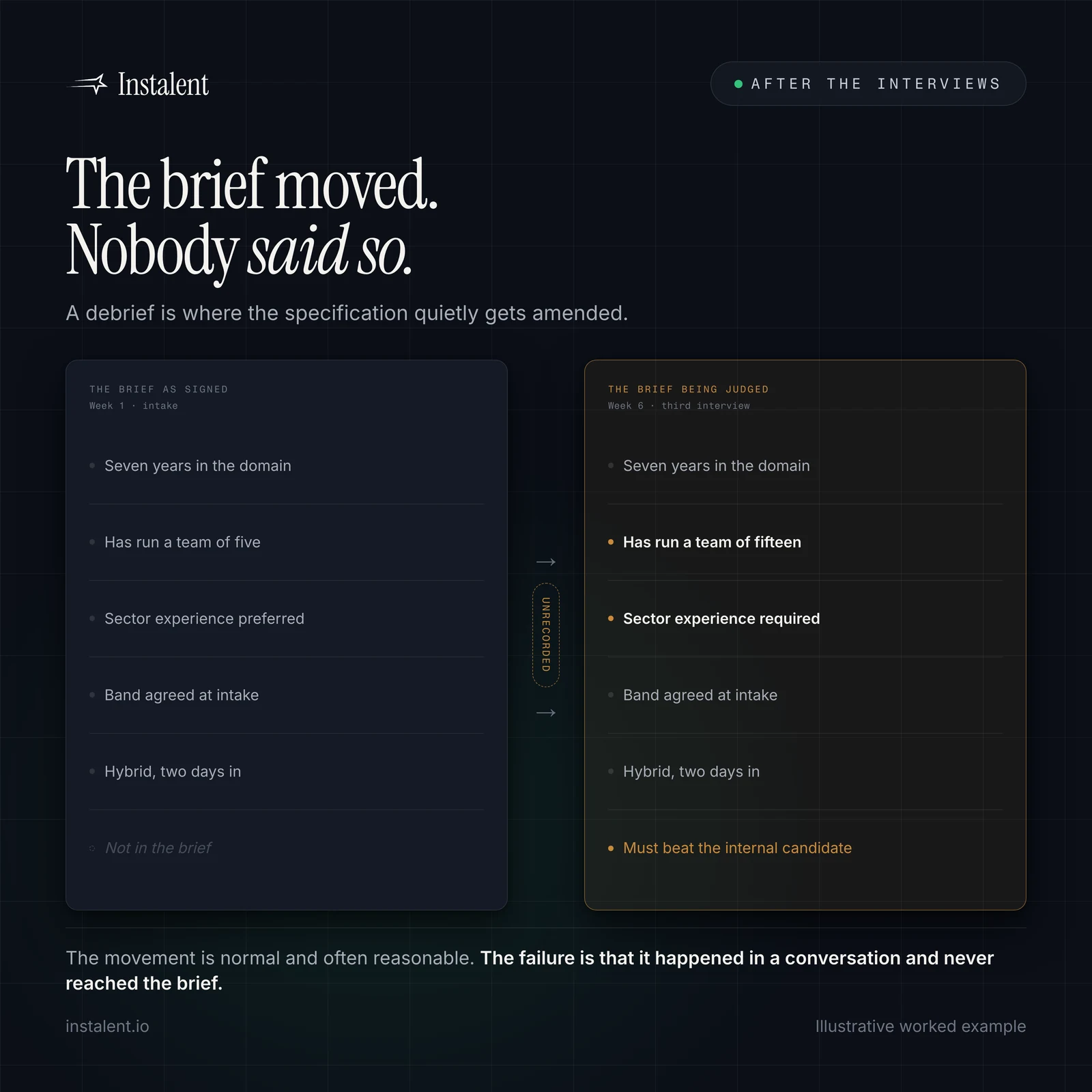
- The brief that was actually worked is not the brief that was signed, and nobody recorded when it moved.
- The date the slate went over is in somebody's sent items.
ATLAS's State of Agency Recruitment: 2026 Benchmark Report, published 16 March 2026 from a survey of more than 1,000 agency recruiters, found only 34.72% describe their processes as "very well-defined and consistent", with a further 22.22% defined but inconsistently followed. That is the mechanism. A record is a by-product of a process being followed, so when the process is loose the record is missing, and the post-mortem has nothing to work with except memory and blame.
Nine fields, captured while the search is live
Every one of these is cheap to record at the moment it happens and impossible to reconstruct later. Each exists to answer one later question.
- The brief as signed, versioned. Answers: did we work the role we were given?
- Must-haves and nice-to-haves, dated. Answers: when did the spec move, and who moved it?
- The comp band and the evidence behind it. Answers: was this ever payable at that number?
- Longlist size at full must-haves, and where it came from. Answers: was the pool real?
- A pass reason per person, written at the moment of the pass. The highest-value field on the list, and the first one to evaporate.
- Slate sent: date and composition. Answers: how long did it take, and what did they actually see?
- Client feedback verbatim, per candidate. Answers: did they reject the person or the spec?
- Every decline and its stated reason. Answers: where did we lose, and to what?
- The process clock. Brief to first slate, slate to feedback, feedback to decision. Answers: whose delay was it?
Capture at the decision, never at review time
A pass reason written six weeks later is not evidence, it is a reconstruction that will quietly rationalise the outcome you already know. The only reliable version is the one written at the moment somebody decided. If recording it is not part of passing on a candidate, it will not exist.
The diagnostic order, because the first failure makes the rest moot
Run these in sequence. The first question that fails is the finding, and everything below it is noise you no longer need to argue about.
- Was the role real? Funded, signed off, with a named decision-maker who had to hire. If not, the search failed before you opened it, and this is a qualification finding.
- Was it payable at that band? Against your own evidence, not a feeling. Salary benchmarking is the version of this you do before accepting, not after losing.
- Was the pool real? Count the honest longlist at full must-haves. If it is forty people nationally, that is a genuine market-structure finding, and it is a finding precisely because it is a number. "Tough market" with a count attached stops being an excuse.
- Did the spec move? A versioned brief answers this in seconds and no amount of recollection answers it at all. Writing a sourcing brief is how you make it answerable.
- Did we reach them? Two separate questions, usually collapsed into one: whether the message arrived, and whether the person was willing to read another approach at all. The second is approach fatigue, and it is a property of the list you built.
- Did the slate match the brief? Scored against the criteria as signed, not against taste. Scoring a shortlist covers the gates-versus-points discipline this needs.
- Did the process lose it? Read the clock. A candidate lost at offer after a nineteen-day feedback gap was lost by the process, and that is the client's finding to own, delivered with dates.
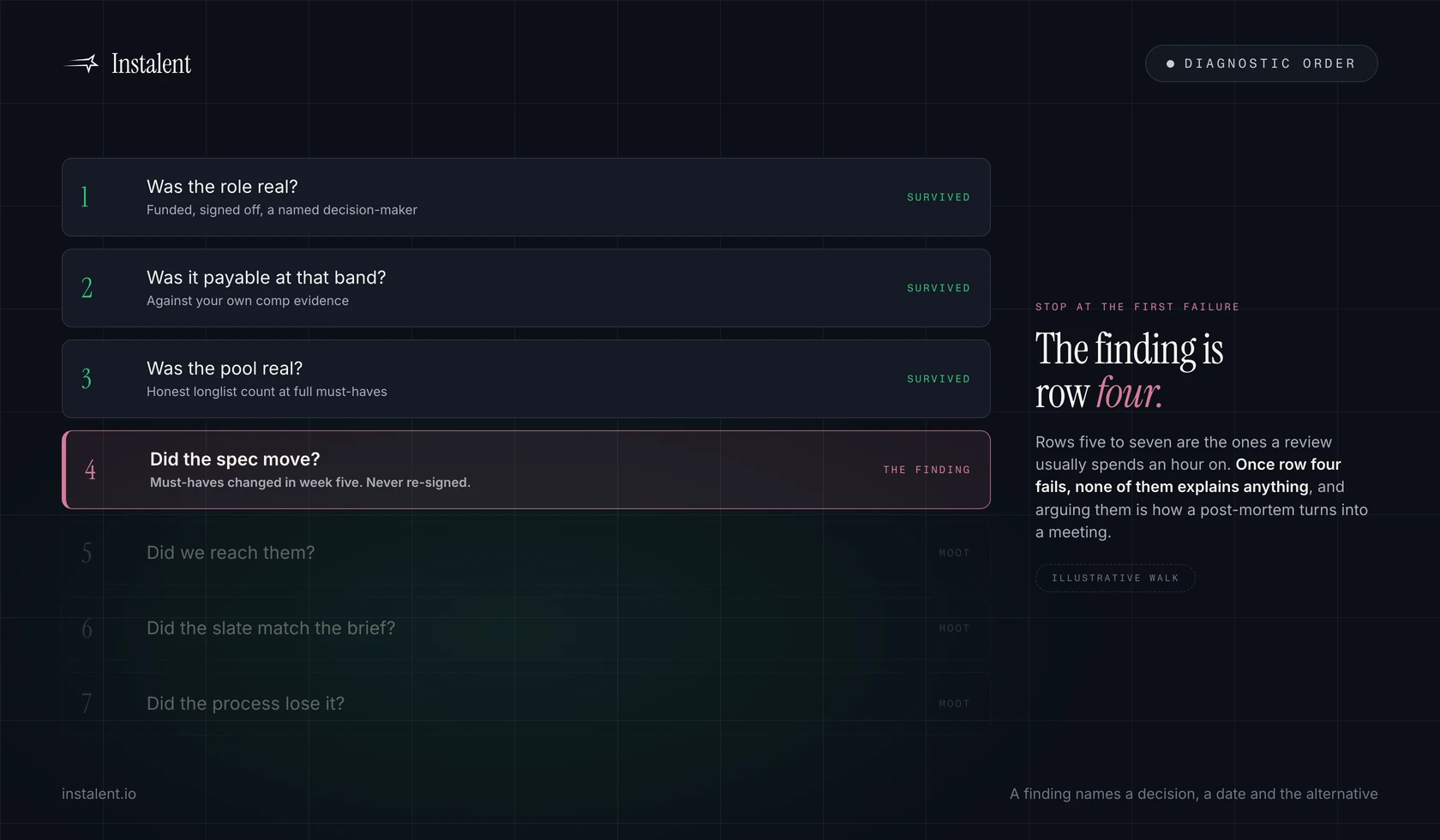
Only once one to six have survived does the market become a legitimate answer, and by then it is a specific one with a count behind it.
What a post-mortem is actually for
Not blame, and not a document nobody reads. Two outputs, both forward-looking.
A qualification rule. The most expensive search in the business is the one you work for ten weeks and never bill. A post-mortem that produces one question you now ask before accepting the next role of this shape is worth more than the fee you lost. This is also where the commercial model bites, and retained versus contingency is the decision it should feed.
A disqualification rule. Some roles should be declined, and the only way a firm learns which ones is by writing down what the last three had in common. Without the record, every one of them looks like bad luck.
Where the record should live
Not in a review document written afterwards. On the search itself, as it runs.
This is the quiet argument for keeping one record per req rather than a trail across a sheet, a mailbox and an ATS. Candidate analysis scores a slate against your criteria and returns the breakdown and the written reasoning per criterion, which is field five captured automatically at the moment of the decision rather than remembered later. Replies landing against the originating record in unified inbox are fields seven and eight. One req, end to end walks the whole thing in order, the reporting discipline is in recruiting metrics formulas, and the agency view is on solutions for recruitment agencies.
A search that fails with a complete record is an asset. A search that fails without one is just a cost.
Want the reasoning recorded while the search runs? Get started
Common questions
What is a search post-mortem?
A structured review of a role that never filled, which names a decision, the date it was made and the alternative that existed at the time. It is different from a hiring post-mortem on someone who was hired and did not work out, and different from a verdict like "the market was tough", which cannot be checked.
Why do most recruitment post-mortems fail?
Because the evidence has already gone. The longlist has been re-filtered, pass reasons were never written down, comp pushback happened on an unrecorded call, and the brief that was worked is not the brief that was signed. ATLAS found only 34.72% of agency recruiters describe their processes as very well-defined and consistent, with 22.22% defined but inconsistently followed, and a record is a by-product of a process being followed.
What should you record during a search?
Nine things, each at the moment it happens: the signed brief with versions, dated must-haves and nice-to-haves, the comp band and its evidence, longlist size at full must-haves, a pass reason per person, the slate date and composition, verbatim client feedback per candidate, every decline and its stated reason, and the process clock from brief to slate to feedback to decision.
In what order should you diagnose a failed search?
Was the role real, was it payable at that band, was the pool real, did the spec move, did we reach them, did the slate match the brief, did the process lose it. The first question that fails is the finding, and the market only becomes a legitimate answer once the first six have survived, with a longlist count attached.
Sources
- The State of Agency Recruitment: 2026 Benchmark Report - ATLAS, 16 March 2026 (survey of 1,000+ agency recruiters; 34.72% "very well-defined and consistent" processes, 29.17% partially defined, 22.22% defined but inconsistently followed).
- Job Openings and Labor Turnover Summary, August 2026 - U.S. Bureau of Labor Statistics, released 29 September 2026 (job openings 7.1 million and hires 5.2 million, both little changed over the month and the year).
Find better candidates, faster
Source, verify and reach candidates on one engine. Get 25% off your first month.
Keep reading