One Req, End to End: What a Search Actually Looks Like on Instalent
A single search walked through stage by stage: the brief, the population, the scored slate, the verified contact, the approach, and what you still decide yourself.
Instalent runs the whole req on one record.
Most software pages describe features. This one describes a shift. One role, from the moment a client sends it to the moment somebody replies, with what you see at each stage and what you still have to decide. The numbers below are a worked example rather than a measurement, and they are labelled as such, because the point is the shape of the work rather than anyone's conversion rate.
Stage one: the brief, written the way you would say it
The search starts in plain language. Not a boolean string, not a filter stack:
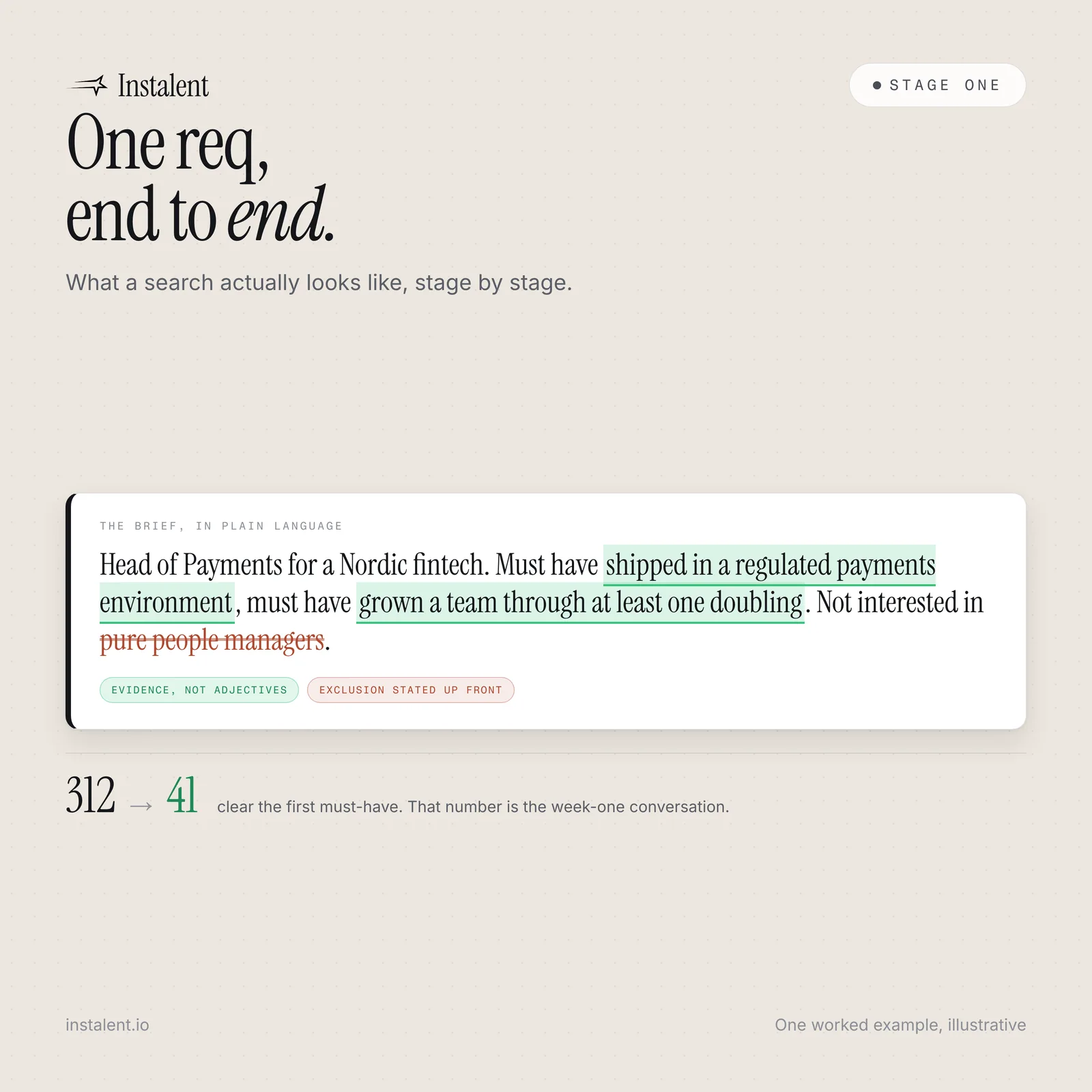
Head of Payments for a Nordic fintech. Must have shipped in a regulated payments environment, must have grown a team through at least one doubling, must have owned the roadmap rather than just the delivery. Not interested in pure people managers who have not been close to the product.
Two things matter here and both are craft rather than software.
The must-haves are written as evidence rather than adjectives, because a requirement that cannot be shown on a profile cannot be scored and belongs in the interview instead. The exclusion is explicit, because on most searches the exclusion list does more work than the inclusion list. Writing a sourcing brief covers getting this right, and it is the single highest-leverage thing on this page.
Stage two: the population, and the number that changes the conversation
The search runs across many sources rather than one network, and results stream in as they are found rather than arriving as a finished export.
The output that matters first is not a list. It is a count. In our worked example the brief returns 312 people, and only 41 of them clear the first must-have.
That number is the one to take back to the client in week one. If a single requirement removes most of the qualified market, that is a calibration conversation to have before you have spent three weeks, not after. Talent intelligence covers using the search itself as market evidence rather than guessing.
The count is the deliverable before the shortlist is
Clients rarely argue with a number that came out of a real search. "Eleven people in this market have actually done this, and nine of them are at your two biggest competitors" ends an argument about salary bands faster than any opinion.
Stage three: the slate, scored against your own criteria
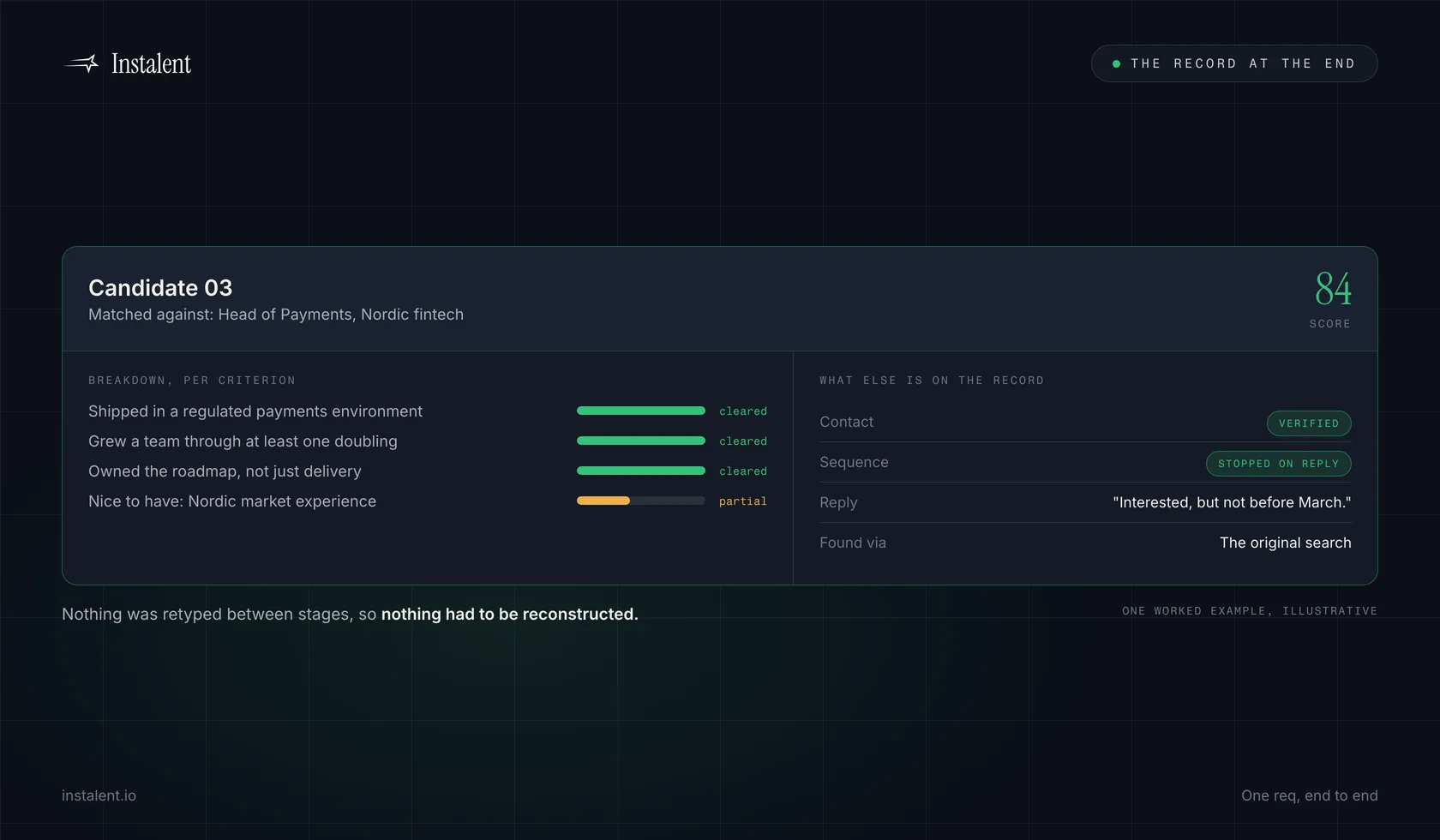
Candidate analysis grades the whole population against the criteria you wrote, in one pass, and returns a score with the breakdown per criterion and a written description of the match.
The breakdown is the part that matters. A score you cannot open is a score you cannot defend the first time a client asks why someone is fourth rather than second. Being able to see which requirement someone missed is also how you discover the requirement itself is wrong.
In the worked example the 41 become 18 who clear every must-have, then 9 worth a personal approach. Scoring a shortlist covers the rubric design that makes those gates hold.
Stage four: the contact, for the people you chose
Enrichment runs after the judgement, not before it, and only for the people you decided are worth approaching. Details are checked across multiple providers and attached to the same profile that already holds the work history and the score.
That ordering is deliberate. Buying contact details for 312 people to approach 9 of them is the most common way a desk spends money on nothing.
Stage five: the approach, and the thing that stops it
Multichannel outreach runs the sequence and stops it the moment somebody answers. That single behaviour is worth more than any amount of template polish, because a sequence that keeps sending after a reply undoes the sourcing that earned it.
If you are sending at any volume, the sending infrastructure matters as much as the copy. Domains, mailboxes and warm-up can be set up inside the product, which is the part most outbound setups discover late. Cold email infrastructure for recruiters covers it.
Stage six: the reply, and where it lands
The answer arrives against the record that produced it, with the score, the breakdown and the history still attached. Nobody has to reconstruct why this person was interesting, which is the failure mode every handoff between systems creates.
From there the shortlist pushes to the ATS you already run, which for us means RecruiterFlow, Greenhouse, Lever or TeamTailor. The thread does not restart.
What you still do yourself
Worth being plain about, because a walkthrough that implies the software does the job is a walkthrough you will resent by week two.
- The brief is yours. The system scores against the criteria you wrote. Write them badly and you will get a confidently wrong slate.
- The judgement call on the near-misses is yours. The breakdown tells you what someone missed. It does not tell you which "not quite" is worth a call anyway, and that is most of the skill.
- The relationship is yours. Nothing here runs the conversation after the reply, and it should not.
- The calibration conversation is yours. The count gives you the evidence. Having the conversation in week one is a choice you still make.
What changes is not that any single step gets faster. It is that the thinking survives from the brief to the reply instead of thinning out at every handoff, which is the argument in Instalent for recruitment agencies. The agency view sits on solutions for recruitment agencies.
Want to run one req this way? Get started
Common questions
Do you have to write the brief in a particular format?
No. It is written in plain language, the way you would describe the role to a colleague. What matters is that the must-haves are phrased as evidence someone could show rather than as adjectives, because a requirement that cannot be shown on a profile cannot be scored.
Why does enrichment run after the scoring rather than before?
Because buying contact details for an entire population to approach a fraction of it is the most common way a desk spends money on nothing. Details are gathered for the people you have already decided are worth approaching.
Can you see why someone scored the way they did?
Yes. The score comes with a breakdown per criterion and a written description of the match. That is what lets you defend a slate to a client and, more usefully, discover that one of your own requirements is wrong.
What does the system not do?
It does not write your brief, make the judgement call on near-misses, or run the relationship after somebody replies. It scores against criteria you wrote, so a badly written brief produces a confidently wrong slate.
Sources
- Bullhorn GRID report: Staffing firms using AI see stronger growth, faster placements - Bullhorn, 25 February 2026 (nearly 2,300 recruitment professionals, fielded November to December 2025; 56% of the highest-growth firms report average placement times under ten days, which is the pace this shape of work is built for).
- The State of Agency Recruitment: 2026 Benchmark Report - ATLAS, 16 March 2026 (survey of 1,000+ agency recruiters; 56.16% describe their tech stack as "functional but fragmented" against 28.77% well integrated, which is the handoff problem this walkthrough is written against).
Find better candidates, faster
Source, verify and reach candidates on one engine. Get 25% off for life.
Keep reading
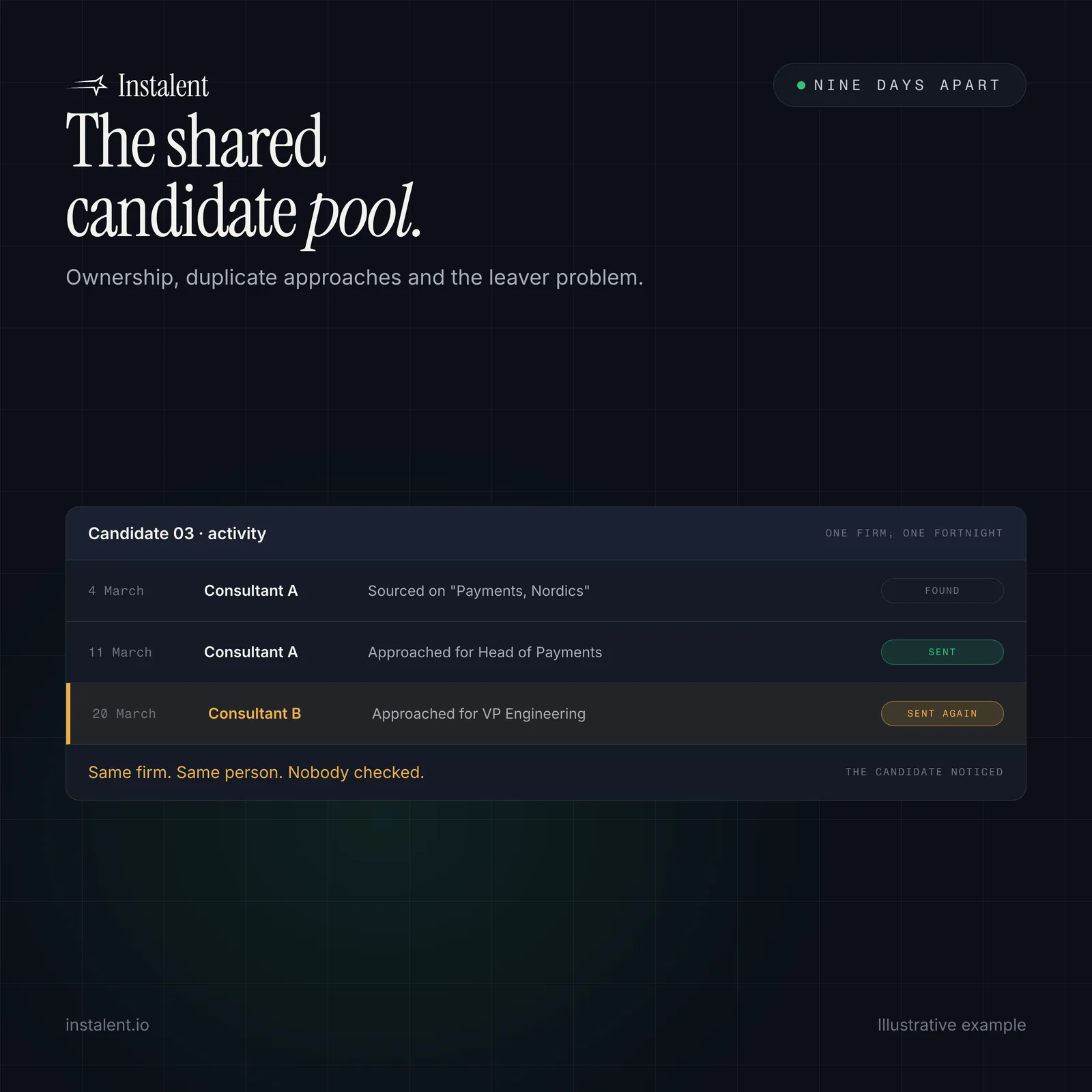
The Shared Candidate Pool: Ownership, Duplicate Approaches and the Leaver Problem
Retained vs Contingency Search: Which One the Search Actually Needs