Approach Fatigue: Your Reply Rate Is a Property of the List, Not the Message
Fewer people are changing jobs while demand holds, so the same candidates absorb every approach. Why reply rates are a list problem, not a message problem.
Build a list the rest of the market has not already worked.
You shortened the message. You moved the ask to the first line. You added a second touch, then a third. You tried the version with the salary in it. The reply rate did not move, so the conclusion arrives on its own: candidates have stopped answering. The more useful conclusion is that you have spent six months optimising the half of the equation that was never the constraint. The message is the part you can change in ten minutes. The list is the part that decides the outcome.
The supply of movers is shrinking, and demand is not
Two public releases, three weeks apart, say the same thing from different directions.
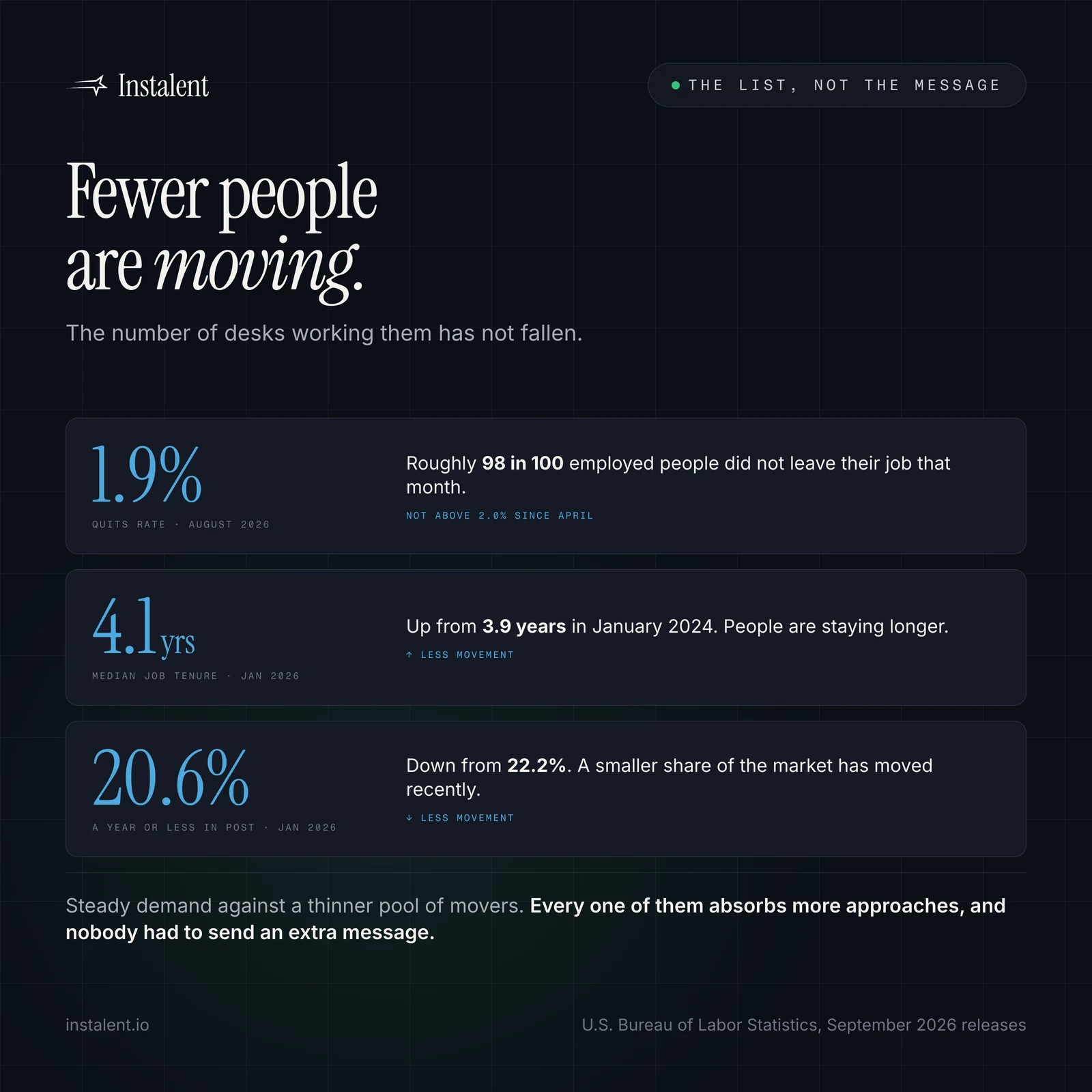
The Bureau of Labor Statistics' Job Openings and Labor Turnover Survey for August 2026, released 29 September 2026, reported 3.1 million quits at a quits rate of 1.9 percent. BLS computes that rate as quits divided by employment, so it reads plainly: in August, roughly 98 in 100 employed people did not leave their job. The rate has not been above 2.0 percent in any month from April to August 2026.
The BLS Employee Tenure release of 24 September 2026 shows the same market from the other side. Median tenure with a current employer was 4.1 years in January 2026, up from 3.9 years in January 2024, and the share of workers with a year or less of tenure fell to 20.6 percent from 22.2 percent over the same two years. Fewer people have moved recently, and the ones in post are staying longer.
Demand did not follow it down. The same JOLTS release put job openings at 7.1 million on the last business day of August, and hires at 5.2 million during the month, both little changed over the month and the year.
Hold those together and the arithmetic of your inbox stops being mysterious. The pool of people who will actually move this quarter got thinner. The number of desks working that pool did not. The average person in it absorbs more approaches than they did two years ago, and not one extra message had to be sent for that to happen.
A benchmark from someone else's funnel is not your benchmark
Search for a reply-rate number and you will find plenty, each from one vendor's own customer base, channel mix and private definition of what counts as a reply. They contradict each other outright: one page's idea of a good rate sits inside another page's idea of a bad one. Nobody outside your business can tell you what your reply rate should be. The only comparison that carries information is your own numbers, split by list.
Why it always looks like a message problem
Because the message is visible and the list is not.
A sourcer can read the message, rewrite it, and see a new number by Friday. The list was assembled upstream, often by whoever was free, out of whatever the obvious search returned. Nobody reviews it, nobody owns it, and it has no quality score attached. So the team iterates hard on the one variable it can see, on top of a list that is structurally saturated, and reasonably concludes that the market has gone quiet.
Three tells that you are looking at the wrong half:
- Your careful message underperforms your lazy one on a different list. If copy were the driver, the ranking would hold across lists. It usually does not.
- Reply rate tracks how findable the profile was. The easier a person was to surface with the obvious string, the worse they answer. That is not a coincidence, it is the whole mechanism.
- The people who do reply are already in three other processes. You are not opening a conversation, you are joining a queue, and you will lose it on speed or on fee.
Approach history belongs on the record
Here is the move that changes the number. Treat when this person was last approached, by whom, and about what as a field on the candidate record, as ordinary as a verified email address.
It has two halves, and they are not equally knowable.
Your own history is fully knowable and almost always lost. It exists, scattered across individual mailboxes, old sequences, a colleague's notebook and three spreadsheets. If two recruiters on the same desk can approach the same person five weeks apart without either knowing, you do not have a reply rate problem, you have a record problem. A shared candidate pool is what makes that history visible, and unified inbox is where the evidence of it already lives.
The market's history is not knowable, but it is predictable. You cannot see who else messaged someone. You can see how discoverable they are, and discoverability is a reasonable proxy for how worked they already are. A profile that surfaces first for the obvious title-plus-tool string surfaces first for everyone.
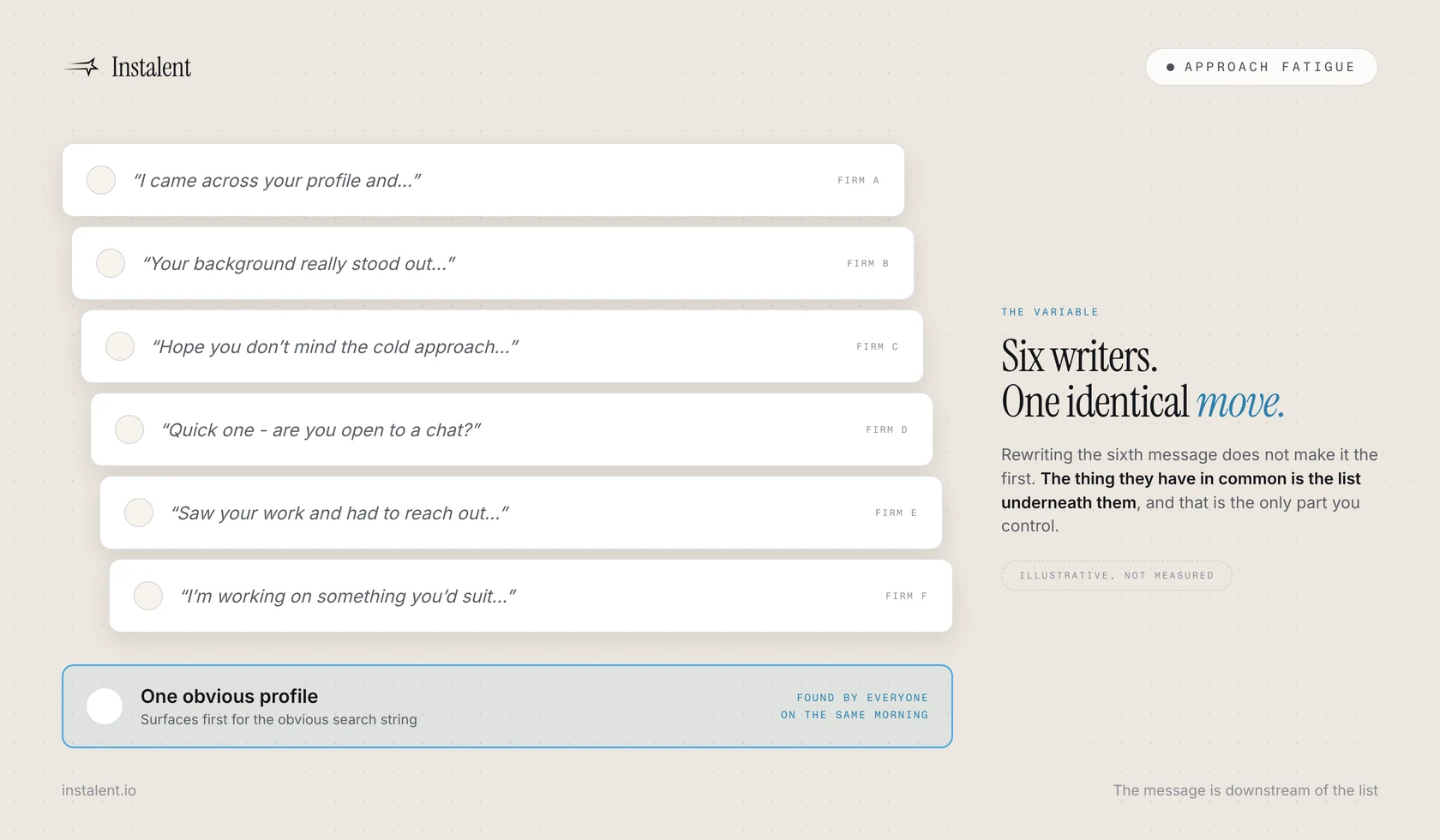
Building a pool the market has not already worked
None of this argues for messaging more people. It argues for messaging different ones.
- Stop sourcing on the obvious string. If a search is easy to write, it has been written. The people it returns are the most-approached slice of the market by construction, and they are the slice your competitors also found this morning.
- Source on evidence of the work, not the label for it. A talk, a repository, a patent, a public write-up, a named contribution. These surface people who are genuinely in the market's blind spot, because their profile was never optimised to be found. Sourcing for judgment is the hard version of this.
- Go one layer out from the feeder list. Everyone in your niche can name the same six feeder companies. The seventh through twentieth are where the same capability sits unworked.
- Mine your own record before the open market. Someone you spoke to eighteen months ago is, to you, a warm first-party contact and, to every competitor, invisible. That is the single cheapest unworked list you own, and talent pipeline is how it stops decaying.
- Set a cooldown and honour it. A person you contacted six weeks ago is not an approach, they are a repeat. Suppress them and spend the slot on someone new.
AI candidate sourcing is where this is meant to pay off: the difference between a search that returns the obvious hundred and one that returns the hundred nobody else constructed. The agency view of the same problem is on solutions for recruitment agencies.
Four numbers worth more than a borrowed benchmark
Replace the industry average you cannot verify with four you can.
- First-approach share. Of the people you contacted this month, what share had never been contacted by anyone at your firm. If this is low, you are recycling.
- Approach recency. Days since this person last heard from you. Anything inside your cooldown is a repeat and should be reported as one.
- Obviousness. What share of a list came back from your single most obvious search string. A high share is a direct measure of overlap with every other desk in your niche.
- Reply rate by list, never in aggregate. One blended number across every list hides the only comparison that would tell you anything.
The formulas and the reporting discipline sit in recruiting metrics formulas, and the sequencing side is in multichannel outreach.
Where this sits next to deliverability and engagement
Worth separating three problems that produce the same silence.
Sender reputation is whether your message physically arrives. That is infrastructure, and it is fixable with infrastructure.
Approach fatigue is whether the person who received it is willing to read another one. That is a property of the population, and no amount of warm-up fixes it.
Candidate engagement is what happens after someone answers. All three can be measured, and only the first two are commonly measured at all.
Want a list the rest of your market has not already worked? Get started
Common questions
What is candidate approach fatigue?
It is the falling willingness of a candidate to respond to any recruiter, caused by how many approaches that person already absorbs rather than by the quality of your message. It is a property of the population you selected, not of your copy.
Is approach fatigue actually getting worse?
The supply side says yes. BLS reported a 1.9 percent quits rate for August 2026, meaning roughly 98 in 100 employed people did not leave their job that month, while median tenure rose to 4.1 years in January 2026 from 3.9 years two years earlier. Job openings and hires were little changed over the year. Fewer movers against steady demand means more approaches land on each person.
What is a good candidate reply rate?
There is no trustworthy external answer. Every published benchmark comes from one vendor's own funnel, channel mix and definition of a reply, and they contradict each other: one page's good rate sits inside another page's bad one. Measure your own rate split by list, and compare lists against each other rather than against someone else's average.
How do you reduce approach fatigue?
Change the list rather than the message. Record approach history as a field so repeats are visible, set a cooldown and suppress inside it, stop sourcing on the most obvious search string, source on evidence of the work instead of the job label, go a layer out from the usual feeder companies, and work your own past conversations before the open market.
Sources
- Job Openings and Labor Turnover Summary, August 2026 - U.S. Bureau of Labor Statistics, released 29 September 2026 (job openings 7.1 million; hires 5.2 million; total separations 5.1 million; quits 3.1 million at a quits rate of 1.9 percent, all little changed or unchanged over the month).
- Employee Tenure Summary - U.S. Bureau of Labor Statistics, released 24 September 2026 (median tenure 4.1 years in January 2026, up from 3.9 years in January 2024; share of wage and salary workers with a year or less of tenure 20.6 percent, down from 22.2 percent).
- Quits: Total Nonfarm (JTSQUR) - Federal Reserve Bank of St. Louis, updated 29 September 2026 (monthly quits rate; 1.9 percent in August 2026, with no month above 2.0 percent from April to August 2026).
- JOLTS: Calculation - BLS Handbook of Methods (the hires, separations and quits rates are the count divided by employment, times 100; the job openings rate uses employment plus openings as its denominator).
Find better candidates, faster
Source, verify and reach candidates on one engine. Get 25% off your first month.
Keep reading