A Fetcher Alternative for Sourcing You Control End to End
A Fetcher alternative that puts natural-language sourcing, verified enrichment and AI fit scoring in your hands - with transparent self-serve pricing to start.
Do this in Instalent - source, verify and reach candidates in one flow.

A Fetcher alternative is worth a look when you want the speed of automated sourcing but more control over who surfaces, how fit is scored, and how you reach them.
Fetcher is an AI recruiter that automates passive and active sourcing and feeds curated candidate batches, then layers scheduled outreach on top. It earns its place: if you are a lean team that needs a steady drip of profiles into your funnel without babysitting the tool, automation does real work. But automation cuts both ways. The same loop that saves you time also decides who surfaces, how they are ranked, and when the next message goes out - and those decisions are hard to see, harder to override mid-stream. If you want a Fetcher alternative where you steer the search directly, Instalent pairs natural-language sourcing with dynamic waterfall enrichment of verified contacts and AI scoring against your own criteria - in one flow - instead of working only from curated batches and a fixed sequence.
This is not an argument against automation. It is an argument for knowing where automation ends and your judgment begins.
How to evaluate a Fetcher alternative, or any sourcing-automation tool
Before you compare two products feature by feature, decide what you actually want the machine to own. Most sourcing tools quietly make four choices on your behalf. Get clear on each before you buy.
The four questions worth asking
- Who decides the search logic? A curated tool infers your intent from a job description and its own model. A self-directed tool lets you write the brief in plain language and rewrite it the moment results look off. The first is faster on day one; the second is faster on day thirty, when you have learned what "good" looks like for this specific role.
- Where do the profiles come from? "AI sourcing" is a black box phrase. Ask which sources are searched. A pipeline that only mines one network misses the engineer who lives on GitHub and the operator who only shows up in a niche community. Breadth matters more than polish.
- How verified is the contact data? A name and a title are not a candidate you can reach. Bounced emails and dead numbers quietly torch your reply rate. Look for enrichment that pulls verified email and phone from more than one vendor and tells you which fields are confirmed.
- Who is being messaged, and when? Scheduled outreach is the headline feature of automation. It is also the one most worth scrutinizing - see the next section.
A simple test
Pull a role you have already filled. Run it through any tool you are evaluating and check the first twenty profiles against the person you actually hired. If the tool would have surfaced and correctly ranked someone like your real hire, it understands the role. If it floods you with adjacent titles, you will be doing the filtering by hand regardless of what the demo promised.
The risk of over-automated outreach
Automated sequences are seductive because they make activity feel like progress. A hundred messages went out; a dashboard turned green. But outreach is the part of sourcing where automation does the most damage when it is wrong, because every message is a touch on a real person's inbox and your brand goes out with it.
The failure pattern is familiar. A scheduled drip fires before anyone reviews the list, so a senior architect gets a note pitching a mid-level role. The personalization token misfires and a raw Hi {FirstName} ships to forty people. The cadence keeps nudging a candidate who already replied "not now," and a warm lead turns cold out of irritation. None of these are exotic - they are the normal cost of letting the machine send without a human in the loop.
The fix is not to abandon automation; it is to put the judgment call back where it belongs. Source and enrich automatically. Score against your criteria automatically. Then you decide who is worth a message and what it says, and let multichannel outreach carry it across email and other channels. The leverage stays; the autopilot risk goes away.
Fetcher vs Instalent
| Fetcher | Instalent | |
|---|---|---|
| Model | Automated/curated candidate batches | Self-directed natural-language search |
| Sources | AI sourcing | The open web - GitHub, company profiles, forums and more |
| Enrichment | Contact data | Dynamic waterfall enrichment: verified email / phone / LinkedIn |
| Scoring | Matching | AI scoring/classification against your criteria |
| Outreach | Automated/scheduled sequences | You approve, then multichannel outreach |
| Pricing | Starter $0 · Growth $149 · Amplify $549 /user/mo | See pricing |
| Rating | 4.6/5 on Capterra (33 reviews) | - |
On Fetcher pricing
Fetcher's listed tiers (via Capterra, as of June 2026) are Starter $0, Growth $149/user/month and Amplify $549/user/month, with Enterprise custom. Independent buyer data (Vendr) puts median annual spend near $11,000 - buyer-reported, not a Fetcher published figure.
Read the table as a spectrum, not a scoreboard. Fetcher leans toward "set it and let it run." Instalent leans toward "show me, then I'll decide." Pick the end that matches how much of the search you want to own.
Control vs curation: where Fetcher sits
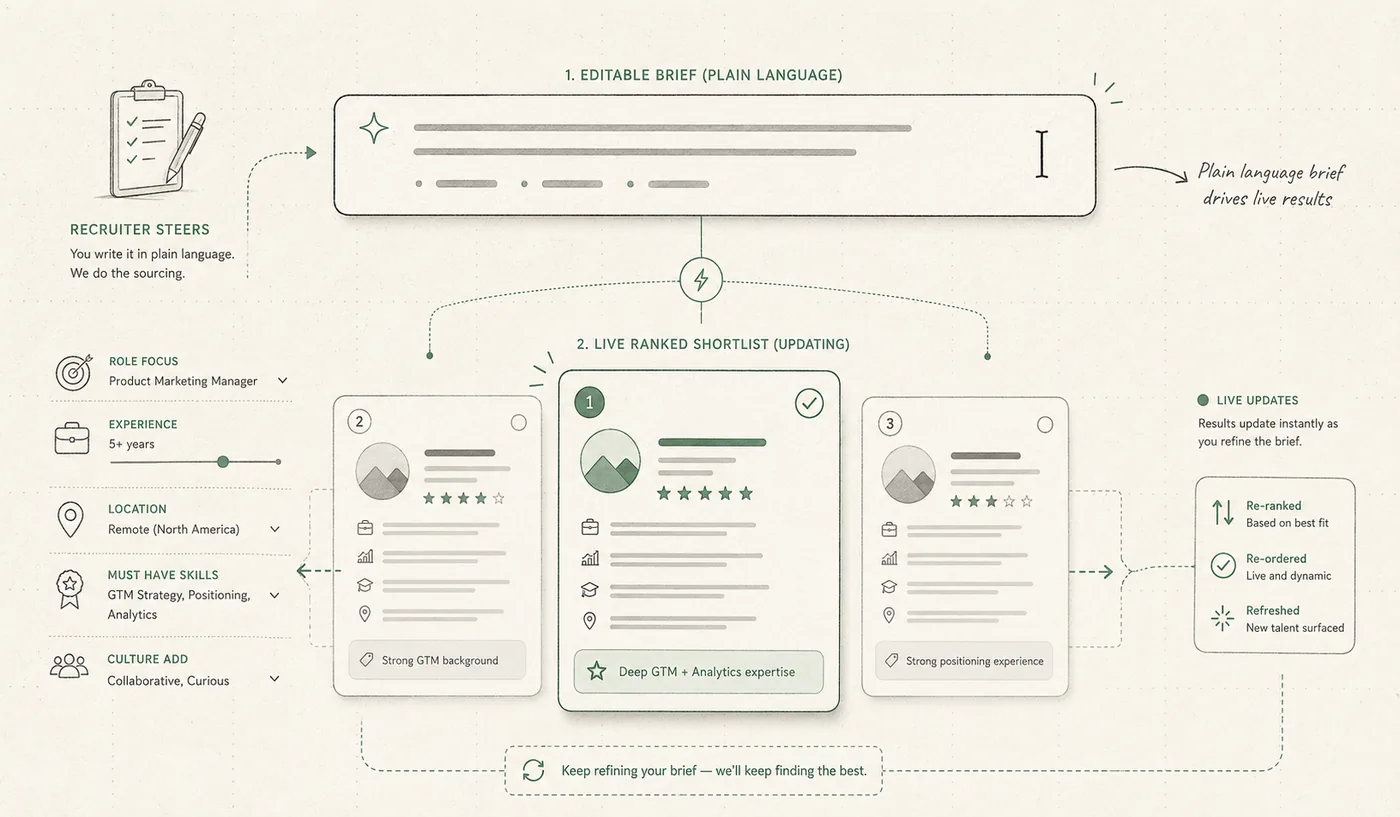
Curated batches save time but hand the search logic to the tool. When the results drift - too junior, wrong geography, the wrong flavor of "fintech" - you are stuck re-tuning inputs and waiting for the next batch. Instalent keeps you in the driver's seat: describe the role, watch results stream in within seconds, refine in plain language, and reach candidates through email sequences and multichannel outreach once you have approved the shortlist.
A concrete workflow
Say you are filling a senior backend role at a Series-B company and you have been burned before by candidates who look great on paper but have never shipped at scale. Here is the loop:
- Write the brief in plain language. "Senior backend engineers in Berlin who have scaled a payments system from startup through growth stage." No boolean strings, no checkbox forms.
- Watch the stream and correct early. Profiles surface in seconds across multiple sources. Three messages in, you notice too many consultants. Add "in-house, not agency" and the shortlist re-sorts.
- Enrich the keepers. Dynamic waterfall enrichment pulls verified email and phone for the dozen you actually like - not the whole list - so you spend credits on people you intend to contact.
- Score against your real criteria. Ask the AI to rate fit against "scaled a payments system" and "stayed three-plus years per role," and read the reasoning, not just the number.
- Approve, then reach out. You pick the eight worth a message, write something that earns a reply, and send via multichannel outreach. The tool never messaged anyone you did not sign off on.
That is the whole difference: same speed at the top of the funnel, your judgment at the bottom of it.
Early customers report 74% less time on search and 3× more profiles reviewed per brief. More on the about page and blog.
Try a free search - paste your role and watch Instalent source, enrich and score candidates in seconds. Start free →
Sources
Find better candidates, faster
Source, verify and reach candidates on one engine. Get 50% off your first month.
Keep reading