AI SDR Agents for Recruitment Agencies: Six Prospecting Agents Compared, and the One Built for the Desk
Can a recruitment agency run business development on an AI SDR agent built for software sales? Six prospecting agents priced and compared, and where a recruiting desk needs more.
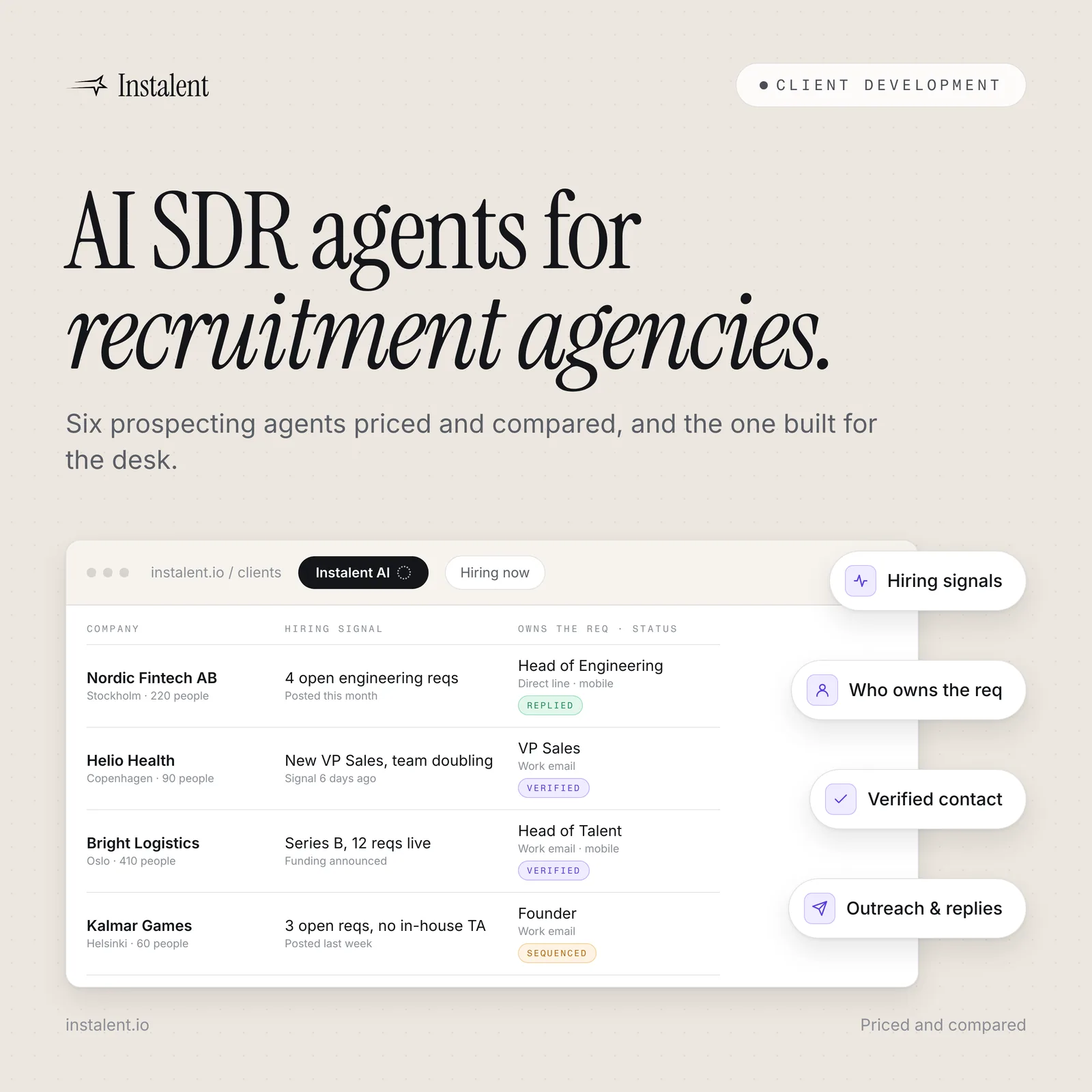
Find the companies that are hiring, the person who owns the req, and a verified way to reach them.
The hardest problem on an agency desk in 2026 is not candidates, it is clients, and the software market has noticed. A whole category of "AI SDR" agents now promises to find your prospects, write the outreach, send it from your own mailboxes and book the meeting while you sleep. They were built for software sales teams. The question every agency owner is asking is whether one of them can run business development for a recruiting desk. Partly, and only if you understand what they are actually good at. Here is what Instalent does for the BD desk first, then six prospecting agents priced and compared, and the five places a recruiting desk needs something the sales tools do not have.
What Instalent does for an agency's BD desk
This post is on our blog, so the honest place to start is with what we built and why. Client prospecting in Instalent is business development designed around the way agencies actually win work:
- Start from the hiring signal, not the firmographic. The trigger for an agency is a company that is hiring: open reqs in your specialism, a team that is growing, a new leader who will build out a function. That is what the search surfaces first.
- Find the person who owns the req. Not "a decision maker at the company", but the hiring manager, head of talent or founder who feels the vacancy. We wrote a whole guide to reaching the actual decision maker, and the product does that work.
- Verify before you send. Contact details are confirmed through verified enrichment from multiple sources, so the first touch does not bounce and your sending domain does not pay for a bad guess.
- Pitch with a candidate. Because sourcing and prospecting share one workspace, the shortlist you built last week is the opener for the client you are approaching this week. That is the pitch an agency wins with and the one no sales tool can make.
- Run the outreach and the replies in one place. Multichannel sequences, follow-ups that stop on reply, and every answer in the unified inbox where the reply agent drafts the next line under your approval.
For the desk that wants to see how this plays out end to end, how recruitment agencies win clients and client market mapping are the two playbooks we would read first.
What an AI SDR agent actually does
Strip the marketing and the category is consistent. An AI SDR agent is a loop: pull prospects from a database of a few hundred million B2B contacts using filters you set, research each one, write a sequence, send it from mailboxes you connect (usually on your own domains), follow up on a schedule, sort the replies into interested or not, and push meetings to a calendar. Some add a voice agent for calls, and the newest entrants have moved toward inbound, answering leads within seconds rather than hunting for them.
Every one of them is built around a sales ideal customer profile, and that assumption is the thing an agency has to test before it buys.
Six prospecting agents, priced and compared
All pricing and positioning below was read on the vendors' own sites on 21 September 2026. Prices change; treat the table as a snapshot.
| Agent | Built for | Data claim | Published pricing (Sept 2026) |
|---|---|---|---|
| 11x (Alice, Julian) | Outbound email and multichannel sequences, plus an inbound phone agent | 50+ data sources | None published; quote only. $70M+ raised |
| Artisan (Ava) | End-to-end outbound from your own domains, human-in-the-loop controls | 250M+ verified contacts | Tiers by volume, roughly 2,500 and 6,000 leads contacted a month; priced per plan, not published |
| AiSDR | Outbound campaigns and meeting generation | 300M+ leads | $250/mo Solo (200 researched contacts, 1 domain, 3 mailboxes); $900/mo Explore (800 contacts, quarterly); $2,500/mo Scale (2,500 contacts) |
| Alta (Katie, Alex, Luna) | Outbound, inbound qualification and signal detection across 50+ sources, including job postings | 50+ data sources | Not published; $25M raised |
| Landbase | Credit-based search, enrichment and agentic outbound | Credits per verified email or mobile | $499/mo (15,000 credits), $1,999/mo, $4,999/mo; about $0.033 per verified email, $0.33 per verified mobile |
| Outcraft AI | Inbound lead engagement across voice, SMS, email and messaging apps | Not stated | Per-lead: $300/mo for up to 100 leads, falling to under $1 a lead at about 4,000 a month (announced 10 September 2026) |
Two things stand out. First, the money is on the axis of people contacted. That makes sense for a software company with a total addressable market of 50,000 accounts and no reason to be selective. Second, only one of the six names job postings as a signal source in its own positioning, and none of them treat the open req as the reason to call.
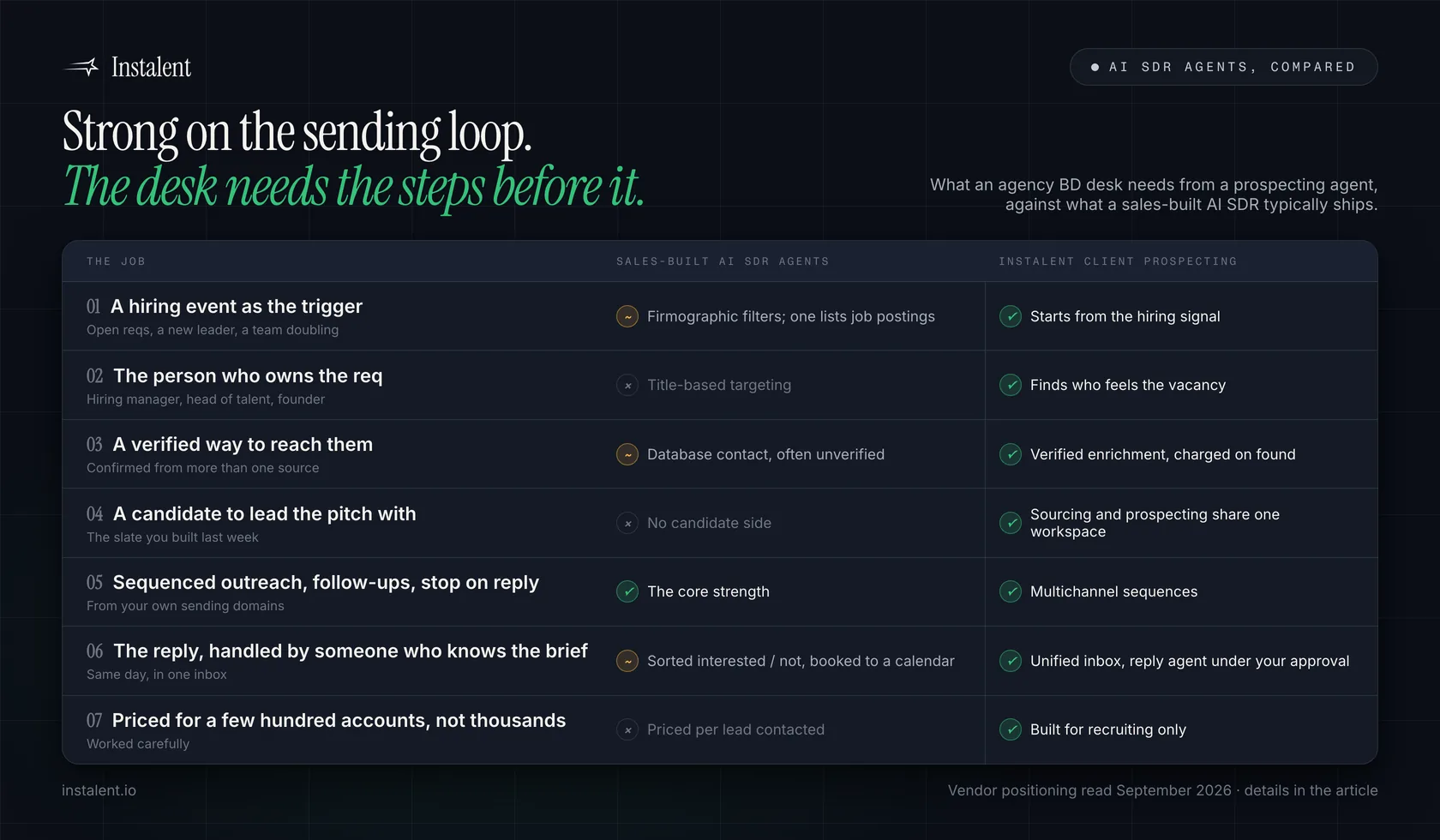
Where a sales SDR agent stops short for a recruiting desk
1. The trigger is a hiring event, not a firmographic. A sales ICP says "fintech, 200 to 2,000 employees, uses Salesforce". An agency's says "opened three engineering reqs this month" or "just hired a VP who will build a team". Most SDR agents can filter on the first and cannot see the second. Alta is the exception in listing job postings among its sources; the rest expect you to bring the list. Buying signals for recruiters is the list of what to look for.
2. The buyer is whoever owns the req. Sales tools default to a title-based target: VP Sales, Head of Marketing, CTO. The person who signs a recruitment agreement is the one with an unfilled seat and a deadline. That is sometimes the CTO and often a line manager two levels down, and the difference is the whole reply rate.
3. The pitch is a person. An agency wins on "I have a payments lead who has done exactly this at a competitor, available in four weeks". A sales SDR can write a sequence about your firm's track record. It cannot source the candidate that makes the sequence land, because it has no candidate side at all.
4. Your clients and your candidates are the same people. The engineer you place this year is a hiring manager in three. The head of talent who briefed you last quarter has moved firm. SDR agents keep prospects in a sales CRM, so that continuity has to be rebuilt by hand. On a desk where sourcing and prospecting share one record, it is just there.
5. The volume is wrong. A specialist agency's BD desk needs a few hundred well-chosen accounts a month, worked carefully, not 2,500 leads contacted. Paying on the contacted axis means paying for the thing you should be doing least.
If you do buy a sales SDR agent, run it like a recruiter
Feed it your own list, built from hiring signals, rather than its database filters. Cap the volume well below the plan allowance. Send only from separate sending domains you own, never the firm's main one, and warm them first; our guide to cold email infrastructure covers the setup. Keep every reply human: the moment a hiring manager answers, the agent's job is over and yours has started.
The alternative built for the desk
The sales SDR category is good at the mechanical loop, and the best of them are very good at it. What an agency needs sits one step earlier and one step later: the hiring signal that says who to call, the person who owns the seat, a verified way to reach them, a candidate to lead with, and a reply handled by someone who understands the brief. That is the shape of Instalent's BD desk, and it runs in the same workspace as the sourcing, so the two halves of the agency finally share a memory.
We scored ten client-prospecting tools on a common rubric in the client prospecting tools round-up; this post is the narrower question of whether the new agent category changes that answer. It does not yet.
Want the companies that are hiring, the person who owns the req, and a verified way to reach them, in one place with your candidates? Get started, or see how it fits an agency desk.
Related reading: why 2026's hardest recruiting problem is clients, recruitment agency growth strategy for the firm-level view, and sales navigator for recruitment agencies for the coverage question.
Sources
- Artisan - Pricing (read 21 September 2026: Team roughly 2,500 leads contacted a month, Scale roughly 6,000, Enterprise custom, pricing scoped per plan; 250M+ verified B2B contacts)
- AiSDR - Pricing (read 21 September 2026: Solo $250/mo, 200 AI-researched contacts, 1 domain, 3 mailboxes; Explore $900/mo, 800 contacts, quarterly contract; Scale $2,500/mo, 2,500 contacts; native database of 300M+ leads)
- 11x (read 21 September 2026: Alice for outbound, Julian for inbound calls; 50+ data sources; no published pricing; $70M+ raised from a16z and Benchmark)
- Alta (read 21 September 2026: Katie, Alex and Luna agents; 50+ data sources including job postings; $25M raised; pricing on request)
- Landbase - Pricing (read 21 September 2026: Starter $499/mo for 15,000 credits, Professional $1,999/mo, Business $4,999/mo; about $0.033 per verified email and $0.33 per verified mobile)
- GlobeNewswire - AI SDR startup Outcraft AI rolls out per-lead pricing for its inbound sales agents (10 September 2026; $300/mo for up to 100 leads, $2 a lead at 1,000, under $1 a lead from about 4,000 a month; €2M pre-seed in April 2026)
Find your next client before your competitors do
Spot companies that are hiring, reach the decision-maker and win the brief. Get 50% off your first month.
Keep reading