Sales Navigator for Recruitment Agencies: What It Costs and Where BD Actually Starts
Sales Navigator for recruitment agencies, priced and assessed honestly: what the seat covers, what agency business development needs on top, and the alternatives.
Do this in Instalent - source, verify and reach candidates in one flow.
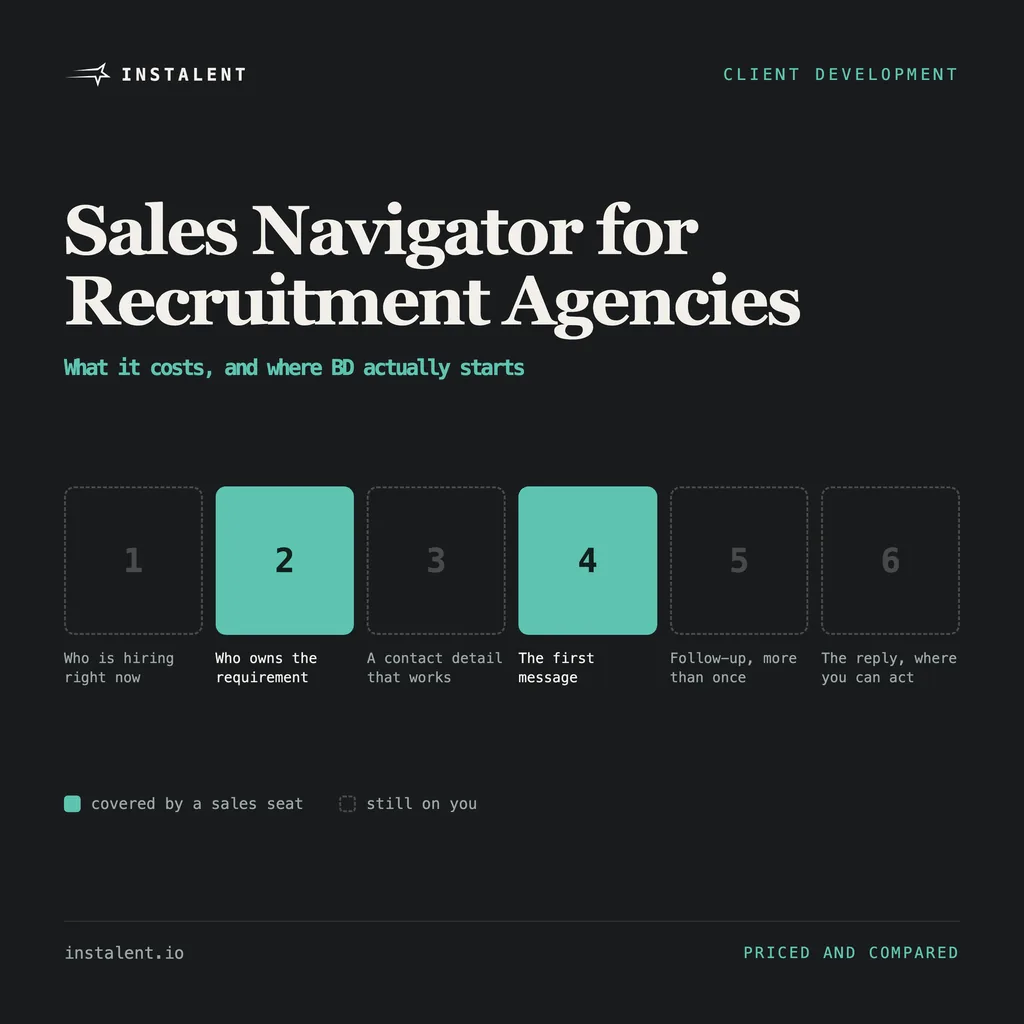
Most recruitment agencies buy a sales prospecting seat because business development obviously needs one, then quietly find that the seat does about a third of the job. That is not a fault in the product. Sales Navigator is very good at what it was designed for, which is one salesperson working a named set of accounts over months. Agency BD is a different shape of work, and the difference has a name: your unit is the hiring event, not the account.
This post is on our blog, so treat the recommendation at the end accordingly. Everything before it is checkable, and the prices come from the vendor's own page.
What does Sales Navigator cost, and what do you get?
LinkedIn publishes the numbers, which already puts it ahead of most of the category.
- Core, US$119.99 a month or US$1,079.88 a year per licence. Fifty-plus advanced search filters, 50 InMail messages a month, Account IQ and Lead IQ for AI summaries, Relationship Explorer, and alerts on saved accounts and leads.
- Advanced, US$159.99 a month or US$1,799.88 a year. Everything in Core plus team seat management, CRM integrations with Salesforce, HubSpot, Microsoft Dynamics and Oracle, lead and contact creation into the CRM, Relationship Map for collaborative org charts, Message Assist and team reporting.
- Advanced Plus, priced on request, adds embedded CRM experiences and buyer intent signals.
What you are buying is a very large, very current graph of people and companies, with good filters over it and a message allowance. For a salesperson who owns thirty accounts and needs to know who moved and who to multi-thread into, that is genuinely strong.
Why agency BD is a different job from sales prospecting
A salesperson's problem is coverage of a fixed account list. They know who the accounts are. The work is getting into them and staying in them.
A recruitment agency's problem is timing. You are selling a service that becomes urgent at a specific moment and is close to unsellable outside it. The trigger is a hiring event: a role opening, a team scaling, a leader arriving with a mandate, a funding round that converts into headcount, a competitor's requirement that has been open for four months and is clearly stuck.
That difference decides everything downstream. A sales prospecting tool indexes people and companies. It does not index hiring events, because its buyer does not need them. So the search that matters most to an agency, which companies are hiring right now and for what, is the one search you cannot run.
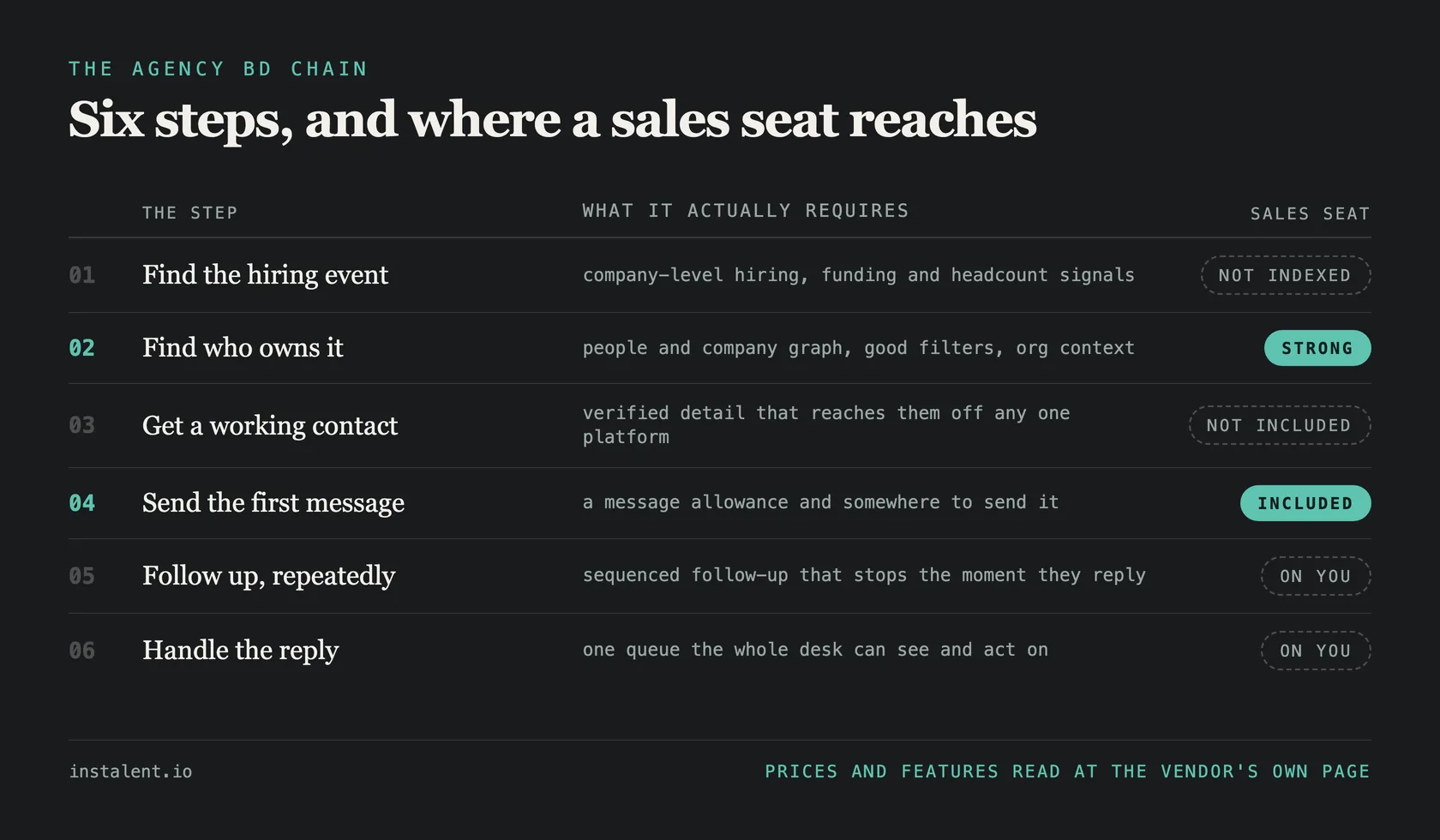
Everything after the trigger is a chain, and the seat only covers part of it:
- Find the companies where a hiring event is happening now.
- Identify who actually owns that requirement, which is often not the person with the tidiest title.
- Get a contact detail that works outside any one platform.
- Reach out and follow up, more than once, without doing it by hand.
- Have the reply land where you can act on it.
- Open the conversation with something specific enough to be worth answering.
What is better than Sales Navigator for agency BD?
Start with the honest framing: better at what. If you want a professional graph with excellent filters, nothing replaces it. If you want the BD chain above covered end to end, that is a different product category.
Instalent is built for that chain specifically. You describe the kind of client you want in plain language, and it finds companies that match and are showing hiring activity, identifies the people who own the requirement, reveals verified contact details from multiple sources, and moves straight into multichannel outreach with follow-up built in, with every reply landing in one inbox that your whole team can see. The same platform runs candidate sourcing, which matters more than it sounds: when a client asks whether you can actually fill the role, you can answer from the same place you found them. Basic is $99 a month.
The other categories worth knowing about, briefly:
- Sales data platforms. Apollo, ZoomInfo and Cognism sell contact databases with outreach attached. Strong data coverage, built around a sales pipeline rather than a req. We compare each of them directly: Apollo, ZoomInfo, Cognism.
- Orchestration. Clay is the power user's answer, letting you wire data sources and enrichment into your own workflow. Real capability, and real setup time.
- Signal sources. Company-level hiring, funding, technology and filing data is available from specialist providers and public registries, and it is the ingredient a sales seat is missing. We list the ones worth knowing in our round-up of the tools senior recruiters actually run.
What it costs once the stack is finished
This is the part that catches agencies out, because the seat is never the whole bill.
A prospecting seat gives you search and a message allowance. It does not give you verified contact details off-platform, and it does not give you sequenced follow-up. So most desks end up adding a contact data tool and a sending tool, each with its own subscription, its own login and its own idea of what a record is. We put published prices against that whole stack in our breakdown of what a recruiting stack costs.
The subscription total is the visible cost. The invisible one is that a person then has to move data between the pieces every day, which on a small desk is a job nobody is paid to do.
Check the seat against your own last ten wins
Before renewing anything, list your last ten clients and write down where each one actually came from. Referral, an inbound enquiry, a candidate who moved into a hiring role, a job advert you spotted, an existing client's new manager. Most agencies find that very little of it came from cold filtered search, which tells you exactly which part of the chain deserves the budget.
When Sales Navigator is still the right call
It would be dishonest to pretend the answer is always the same, so here is when we would keep it.
- Enterprise and MSP motions. If a single client relationship takes nine months and five stakeholders, the relationship mapping and multi-threading is exactly the right tool, and there is no substitute for it.
- Relationship-led desks with a small named account list. If you already know the fifty companies you want and the work is staying visible inside them, that is what it is built for.
- Teams whose CRM is the centre of gravity. The Advanced tier's CRM integrations are mature in a way most alternatives are not.
The case for changing is different and specific: your BD is event-driven, your target list is not fixed, and you are losing time to the parts of the chain the seat does not cover.
A two-week test that settles it
Do not argue about this in the abstract. Run both for one fortnight.
- Pick one segment you actually want more of. Not "tech", something you could name twenty companies in.
- Week one, work it the way you do now. Record how many companies you identified, how many you reached the right person at, and how many replied.
- Week two, work it starting from hiring activity rather than from an account list. Same segment, same effort, same recording.
- Compare the two on conversations booked, not on activity. Activity always looks fine.
Two weeks is enough because BD compounding is slow but the top of the funnel is not. If week two produces more real conversations from the same hours, you have your answer, and you have it in a form you can show a partner.
Want the whole chain in one place? Instalent finds the companies hiring, identifies the person who owns the requirement, verifies the contact details, runs the outreach and follow-up, and puts every reply in one shared inbox, alongside the candidate sourcing that lets you deliver on what you sold. Get started for seven days, or see how it fits a recruitment agency.
Sources
- LinkedIn Sales Solutions - Compare Sales Navigator plans (accessed 18 August 2026: Core "US$119.99/month or US$1,079.88/year" with 50+ advanced search filters, 50 InMails per month, Account IQ and Lead IQ, Relationship Explorer and alerts; Advanced "US$159.99/month or US$1,799.88/year" adding team seat management, CRM integrations with Salesforce, HubSpot, Microsoft Dynamics and Oracle, Relationship Map, Message Assist and team reporting; Advanced Plus priced on request with buyer intent signals and embedded CRM experiences)
Find better candidates, faster
Source, verify and reach candidates on one engine. Get 50% off your first month.
Keep reading