A Seamless.AI Alternative for Recruiters: When a Sales Contact Database Is the Wrong Half of the Job
A Seamless.AI alternative for recruiting desks. What the contact database does well, what it costs, and the three things a recruiter needs that a sales lead engine cannot do.
Find the person by what they have done, not by the title on their badge.
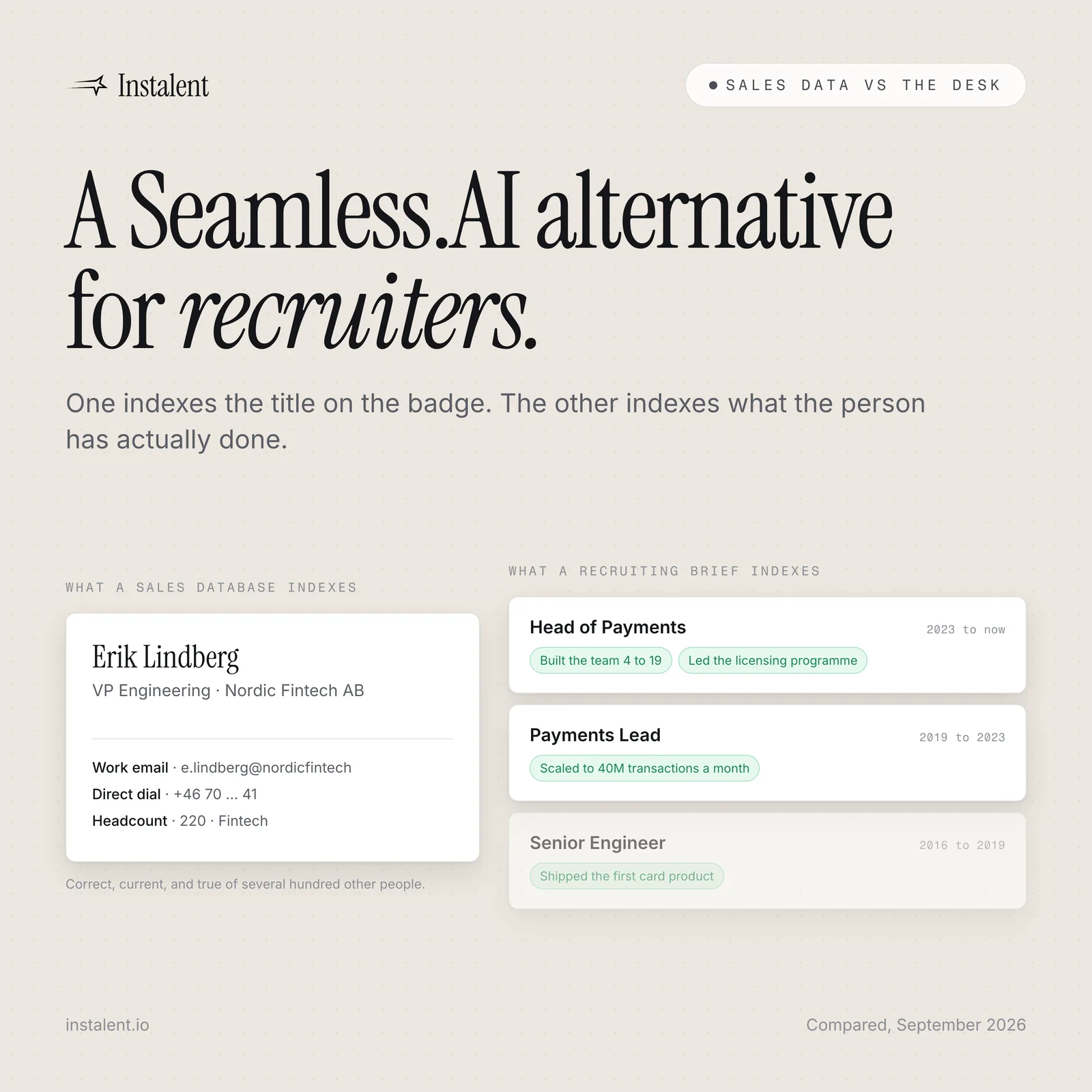
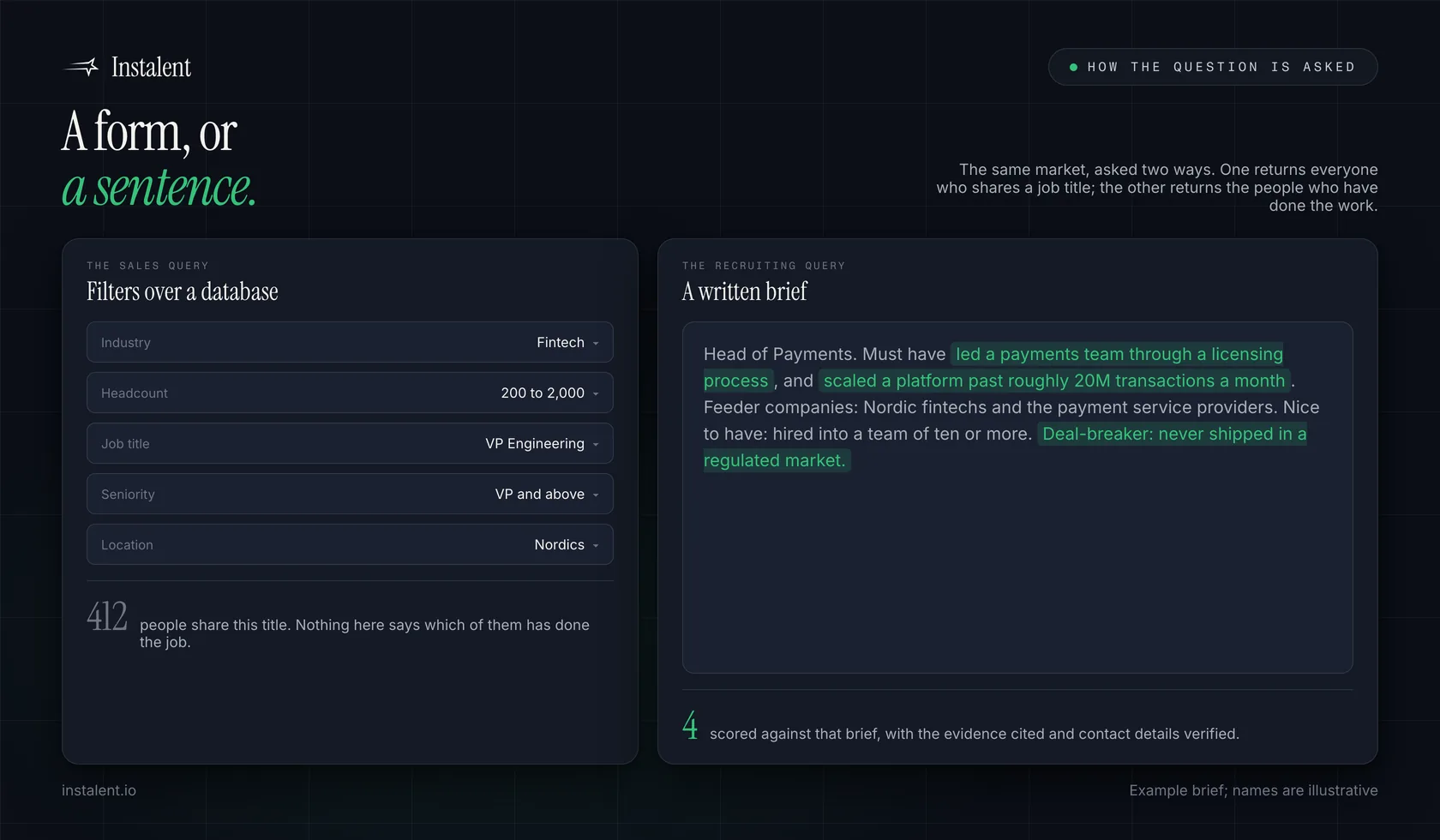
Seamless.AI is a very good answer to one question: who works at this company, and how do I reach them right now. It calls itself a real-time search engine rather than a static list, it claims 1.8 billion verified business emails and 414 million phone numbers, and a lot of sales teams swear by it. For the client half of an agency desk that is genuinely useful. For the candidate half it is the wrong shape of tool, and not because it is bad. A sales contact database is built to answer a question about a job title at a company. Recruiting asks a different question entirely: who has done this work, and would they move.
What Instalent does differently
This is our blog, so here is our answer first, and the difference is in the question each tool is built to answer.
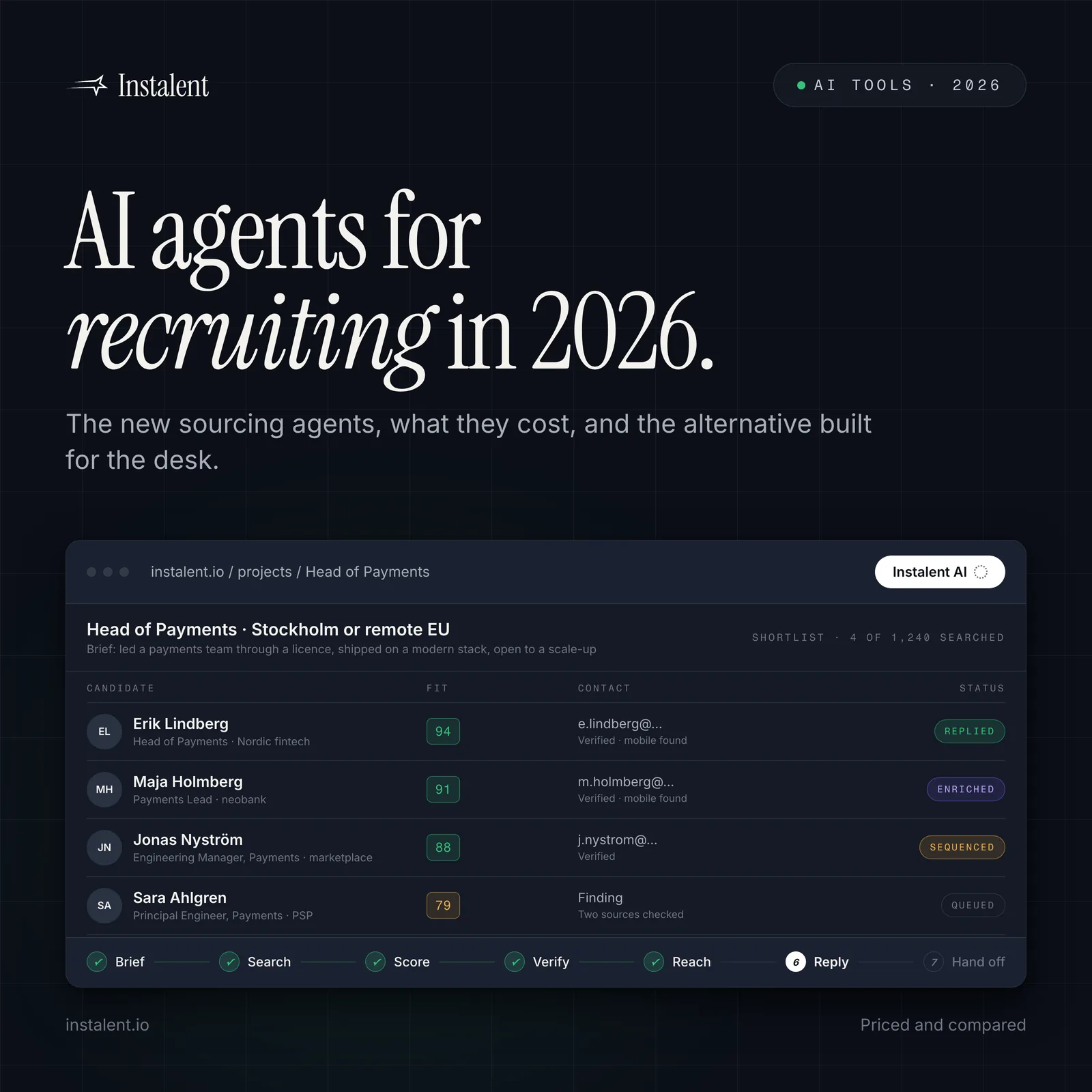
- Search by evidence, not by title. AI candidate sourcing works from a written brief and looks for people whose history matches it: the work they shipped, the companies they did it at, the scale they did it at. Title is an input, not the index.
- Score the whole list against one rubric. Candidate analysis ranks every profile with the evidence cited, so the shortlist survives a hiring manager asking why.
- Verified contact details, charged only when found. Enrichment from multiple sources runs a cascade until it confirms a way to reach the person, and you pay on success rather than on lookup.
- Outreach and the reply in one place. Multichannel sequences that stop the moment someone answers, with every reply in the unified inbox, tied to the campaign and the profile.
- The client side too. Client prospecting starts from hiring signals, so business development and delivery run on one engine.
What Seamless.AI is genuinely good at
Seamless.AI has a real technical argument and it is worth stating properly rather than strawmanning it. Most contact databases are snapshots: someone crawled a source, wrote a row, and that row decays from the day it was written. Seamless positions itself as a search engine that verifies at lookup time, which is the right instinct, because contact data goes stale faster than almost any other kind.
Its own figures, read on 25 September 2026: 1.8 billion verified business emails and 414 million phone numbers, with more than 100 live data points per profile, updated continuously. It bundles buyer intent, job change tracking and enrichment, and has recently added email, calling and task management inside the product. G2 named it the number one highest satisfaction product of 2025 in its own awards.
On the pricing page
As of 25 September 2026 there is no published price. Free gives you 1 user and 50 credits. Pro is per user with annual credit packages. Enterprise is unlimited users on custom packages. Both paid tiers route to a sales conversation. That is a legitimate way to sell, and it is worth knowing before you plan a trial around it, because you cannot self-serve your way to a real evaluation the way you can with a published monthly price.
Three gaps that only show up on a recruiting desk
1. The index is a title at a company. The question is a career.
A sales database is organised the way a sales team thinks: accounts, then titles inside them. You filter to VP Engineering at 400 fintechs and you get 400 rows. That is the correct answer for someone selling software to engineering leaders.
A recruiter filling a payments lead role does not want every person carrying that title. They want the person who built a payments team through a licensing process at a company of roughly this size, who might be ready to move. Those two searches share a job title and nothing else. We wrote up how to specify that properly in how to write an AI sourcing brief.
2. Work contact details are the wrong ones for passive candidates.
A B2B database holds business emails and direct dials, because that is what a salesperson needs. A passive candidate reading a message about leaving their current employer, on their current employer's mail system, is a different proposition. This is not a data quality complaint, it is a fit one: the same contact record that is ideal for a sales pitch is awkward for a career conversation.
3. Nothing connects the contact to the role.
The record knows an address and a company. It does not know that this person is second on a four-person slate, that the hiring manager asked for someone with licensing experience, or that the sequence should have stopped when they replied on Tuesday. Everything that makes outbound a recruiting activity rather than a mail merge lives above the contact layer. Recruitment reply management covers what that costs when it is missing.
Seamless.AI vs Instalent
| Seamless.AI | Instalent | |
|---|---|---|
| Built for | B2B sales teams finding and reaching buyers | Recruiting desks filling roles and winning clients |
| The search | Company and title filters over a contact database | A written brief matched against what people have done |
| Data claim | 1.8B+ business emails, 414M+ phone numbers, 100+ live data points per profile | Open-market search plus verified enrichment from multiple sources |
| Contact data | Credit-based lookups on business contact details | Verified on the cascade, charged only when a value is found |
| Ranking | Filters and intent signals | Every profile scored against your rubric, evidence cited |
| The role | No model of a req or a shortlist | Candidate, shortlist and req are the unit of work |
| Outreach | Email, calling and tasks inside the product | Multichannel sequences that stop on reply, unified inbox, agent drafts under approval |
| ATS | Not a focus | Two-way with RecruiterFlow, Greenhouse, Lever, TeamTailor |
| Pricing | Free tier; Pro and Enterprise on request | Plans that bundle sourcing, verification, scoring and outreach, see pricing |
Where Seamless.AI still earns its place
Three honest cases, and the first one is real enough that plenty of agencies should act on it:
- Client business development. Finding the head of talent or the hiring manager at a company you want to pitch is a sales-shaped problem, and a sales-shaped tool solves it well. If your BD is stalled for want of contact details, this category helps.
- Phone-first outreach. 414 million phone numbers is a serious asset if your desk actually picks up the phone, and many of the best still do.
- You already run a sales motion. If your firm sells anything alongside placements, one contact platform across both is a reasonable simplification.
What we would not do is run candidate sourcing on it and expect the shortlist to arrive. That is not a knock on the product. It is a different product.
Want a search that starts from the brief rather than the job title? Get started, or see how it fits an agency desk.
Related reading: an Apollo alternative for recruiting for the closest comparison in this category, the best AI sourcing tools in 2026 scored on one rubric, and buying signals for recruiters for the client half of the desk.
Sources
- Seamless.AI (read 25 September 2026: described as "a real-time search engine that helps B2B companies find accurate sales leads"; "1.8B+ verified business emails and 414M+ phone numbers"; "100+ live data points per profile, updated continuously"; company claims of "Trusted by 1M+ sales leaders worldwide"; "#1 Highest Satisfaction Product of the Year" at the G2 2025 awards)
- Seamless.AI - Pricing (read 25 September 2026: Free plan with 1 user and 50 credits; Pro sold per user with annual credit packages and unlimited exports, contact sales; Enterprise for unlimited users on custom packages with a dedicated success manager, contact sales; no price published on any paid tier; email, calling and task management listed as included)
Run your own side-by-side test
Source, enrich, score and reach out in one flow, and judge it against your current stack. Get 50% off your first month.
Keep reading
An Amplemarket Alternative for Recruitment Agencies: Right Machine, Wrong Signal
AI Agents for Recruiting in 2026: The New Sourcing Agents, the Ones That Already Closed, and the Alternative Built for the Desk