A Paraform Alternative for Recruiters Who Want to Own the Client
A Paraform alternative for recruiters and agencies: Paraform is a marketplace that hands you roles for a fee split. Instalent helps you find your own clients, source, and keep the whole fee.
Find the companies that are hiring and the person who owns the req. Your client, your fee, your data.
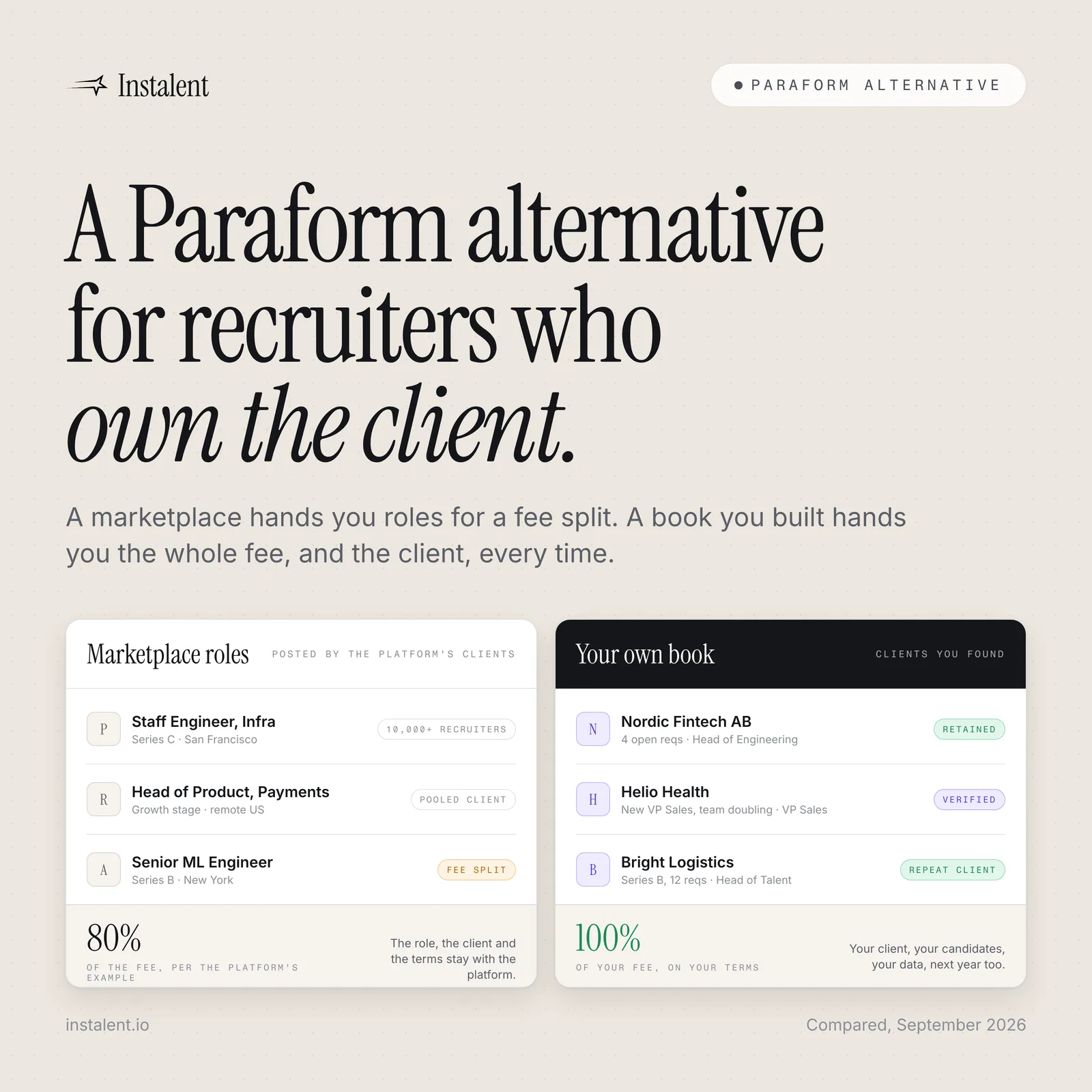
Paraform has done something genuinely useful for independent recruiters: it built a marketplace where more than 1,000 companies post roles and 10,000-plus vetted recruiters work them for a success fee, with AI sourcing and matching tools thrown in. Recruiters on the platform have earned more than $50 million, and it raised a $40 million Series B in March 2026 to keep going. That is real traction, and if you want deal flow without doing business development, it is worth a look. The trade is the point of this post. On a marketplace the client is the platform's, the fee is split, and you are one of thousands working the same req. If you would rather own the client, the fee and the relationship, you need a different kind of tool. Here is what that looks like.
What Instalent does for a recruiter who wants their own clients, first
This is our blog, so the fair place to start is with what we built. Instalent is not a marketplace and does not take a share of anything. It is the engine for building and working your own book:
- Find the clients yourself. Client prospecting surfaces companies with hiring signals in your specialism (open reqs, a growing team, a new leader), finds the person who owns the req and confirms how to reach them. The decision-maker guide covers the craft; the product does the work.
- Win the search with a candidate. Because sourcing and prospecting share one workspace, the shortlist you built last week is the opener for the client you approach this week. That is the pitch a marketplace cannot make for you.
- Source and score. AI candidate sourcing from a written brief, and candidate analysis that scores every profile against the same rubric with the evidence cited.
- Verify and reach. Enrichment from multiple sources, charged only when a contact is found, and multichannel sequences that stop on reply, with every answer in the unified inbox.
- Keep everything. Your clients, your candidates, your notes and your conversations are yours, exportable, in one place.
Priced as a subscription, with transparent self-serve pricing. Your fee is your fee.
What Paraform is built for
Paraform is a marketplace. Companies (its site names Palantir, Rippling, Abridge, Scale AI and others) post roles; recruiters on the network work them and are paid on placement. The pitch to a company is speed and quality without an agency contract: Paraform says companies typically meet the candidate they hire in around 12 days, and cites a 70% interview rate for submitted candidates. The pitch to a recruiter is deal flow: "access 1,000-plus highly vetted clients", AI agents that surface roles and handle busy work, plus a CRM, notetaker and scheduler, and an account manager.
Its numbers are real and worth respecting. Recruiters have earned more than $50 million on the platform, and Paraform says top recruiters have doubled their revenue in under a year, some earning more than $300,000 in a single month. The average candidate hired through it earns about $260,000 a year, which tells you the roles are senior technical and product searches at well-funded companies.
On the economics
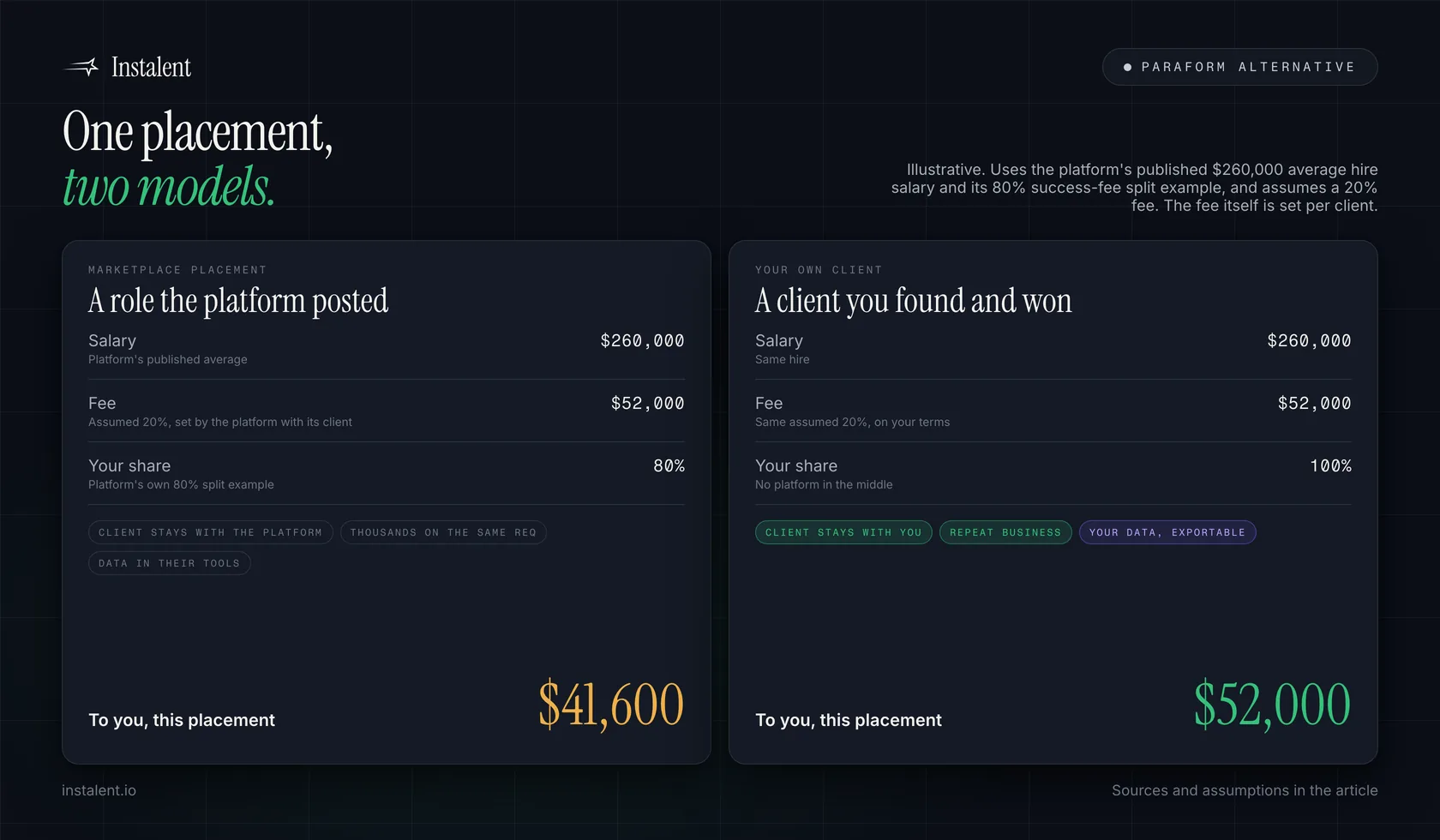
Paraform does not publish a fee schedule. Its recruiter page illustrates the model with an "80% success fee split", and the company sets terms with each client. Read that as: for every placement, a share of the fee stays with the platform, and the role, the client and the terms are Paraform's. We quote only what the site shows and make no claim about any specific recruiter's arrangement.
The trade you make on a marketplace
None of this makes Paraform a bad deal. It makes it a specific deal, and an agency owner should see it clearly before building a business on it.
- The client is the platform's. You do not hold the contract, the terms or the relationship. When the role closes, the account goes back to the pool. Repeat business, the thing that makes an agency worth owning, accrues to the marketplace.
- You compete with thousands on the same req. Ten thousand recruiters and a thousand companies is a lot of recruiters per role. Speed to a credible shortlist decides who gets paid, and the sourcing tools are the same for everyone.
- The fee is split. An illustrative 80% share of a success fee is generous by marketplace standards. It is still 20 points below the fee on a client you found yourself, on every placement, forever.
- The data lives there. The candidates you found, the notes you took and the conversations you had sit inside the marketplace's tools. Ask about export before you depend on it.
- The roles are theirs to choose. A marketplace's deal flow is whatever its clients post this quarter. A book you built is whatever your specialism is.
Paraform vs Instalent
| Paraform | Instalent | |
|---|---|---|
| What it is | A recruiter marketplace with AI tools | A sourcing, prospecting and outreach engine for your own desk |
| Where clients come from | The platform's 1,000+ companies post roles | You find them: hiring signals, the person who owns the req, verified contact |
| Who owns the client | Paraform | You |
| How you are paid | A share of the success fee, per placement, through the platform | Your fee, on your terms, invoiced by you |
| Sourcing | AI sourcing and matching inside the marketplace | Open-market search from a written brief, scored with the evidence cited |
| Contact data | Provided within the platform's tools | Verified enrichment from multiple sources, charged only when found |
| Outreach | Recruiter tools plus the platform's client relationships | Multichannel sequences, unified inbox, reply agent under your approval |
| Competition | Thousands of recruiters on the same roles | Your book, your specialism |
| Cost | No subscription; a fee share on placement | A subscription; no share of any fee |
The two are not really substitutes. Paraform sells deal flow and charges for it in fee share. Instalent sells the capability to generate your own deal flow and charges a subscription. The question is which business you want to be running in three years.
A Paraform alternative workflow: build the book in a month
- Pick the specialism you actually place in. One function, one seniority band, one or two geographies. Marketplaces reward generalists; a book rewards depth.
- Pull the hiring signals. In client prospecting, list the companies that opened reqs in that specialism this month, plus the ones that just hired a leader who will build a team. Buying signals for recruiters is the full list of what to watch.
- Find the person who owns the req and verify their contact details before the first touch.
- Build the slate first. Source and score four people against a brief you wrote from the public req. Lead the outreach with one of them.
- Sequence, stop on reply, answer the same day. Every response into the shared inbox; the agent drafts, you approve.
- Keep the client after the placement. The engineer you place is a hiring manager in three years. The head of talent who briefed you moves firm. That continuity is the whole point of owning the book.
You can do both
Plenty of recruiters work marketplace roles for cash flow while they build their own book. The mistake is doing only the first and calling it a business. If you use Paraform, use it with your eyes open, and put the BD hour in the diary anyway.
Where Paraform still fits
A solo recruiter starting out with no clients, a strong network in a hot technical specialism and no appetite for business development will earn on Paraform faster than they will earn cold. The companies are real, the roles are senior and the payouts are documented. If that is you, it is a good place to be for a year. This post is for the recruiter who wants what comes after that year.
Want your own clients, your own fee and your own data? Instalent finds the companies that are hiring, the person who owns the req and a verified way to reach them, and runs the sourcing on the same engine. Get started, or see how it fits an agency desk.
Related reading: how recruitment agencies win clients, recruitment agency growth strategy for the firm-level view, and the solo recruiter playbook for running both halves of the desk alone.
Sources
- Paraform - Announcing Paraform's Series B with $65M raised to date (18 March 2026; $65 million total raised, Series B led by Scale Venture Partners with Felicis, A* Capital and Liquid 2 Ventures participating; 1,000+ companies helped; companies typically meet the candidate they hire in around 12 days; recruiters have earned over $50 million; top recruiters have doubled revenue in under a year, some earning more than $300,000 in a month; average candidate hired earns about $260,000 a year)
- Axios Pro - Paraform raises $40M Series B led by Scale VP (18 March 2026; $40 million round, CEO John Kim)
- Paraform - For recruiters (read 21 September 2026: "Access 1,000+ highly vetted clients", the "Success fee split: 80%" example, ATS, email and calendar integrations plus account managers)
- Paraform - Home (read 21 September 2026: 10,000+ expert recruiters, 1,000+ companies, 70% interview rate, named customers including Palantir, Rippling, Abridge and Scale AI, recruiter toolkit of sourcing, matching, CRM, notetaker and scheduler)
Find your next client before your competitors do
Spot companies that are hiring, reach the decision-maker and win the brief. Get 50% off your first month.
Keep reading
Recruiting Trends 2026: The Hiring Problem Is No Longer Access. It's Signal.
AI Recruiter: What It Actually Is, and Whether It Replaces You